A fire doesn’t need a door left open to spread through a building. It needs a gap in the wall, and most Irish homes have dozens of them.
Those gaps are called cavities. They’re the concealed spaces inside walls, floors, and ceilings that exist in virtually every building. In a fire, they become hidden highways for heat, smoke, and flames to travel far beyond where the fire started.
A cavity barrier is the passive fire protection product that seals those spaces. This article explains what cavity barriers are, how they work, where they go, and what Irish building regulations require. You’ll also find out how to check whether your property is properly protected.
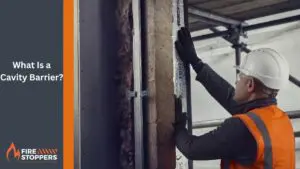
What Is a Cavity Barrier?
A cavity barrier is a physical seal installed inside the concealed spaces of a building. It stops fire and smoke from travelling through those hidden channels from one part of the building to another.
Cavity barriers are a passive fire protection measure. That means they work automatically, without electricity, without manual activation, and without anyone needing to do anything. They sit in position inside the wall or ceiling void and respond when temperatures rise.
They’re not visible once a building is finished. Most homeowners have never seen one. That’s partly why so many properties are missing them.
For a full overview of how cavity barriers sit within a wider fire safety system, see Firestoppers’ passive fire protection services.
How Fire Travels Through a Building’s Hidden Spaces

Imagine the space behind your plasterboard as a vertical shaft running the full height of your house. Hot gases and smoke rise. With nothing blocking the path, they travel upward through that shaft faster than they move across an open room.
This is called fire spread via concealed cavities. Post-fire investigations regularly show damage on floors above where the fire actually started. The building’s own structure acted as the route.
Cavity barriers break that path by compartmentalising the hidden space. They’re positioned at intervals so fire can’t travel more than a set distance before hitting a seal.
Where Cavity Barriers Are Installed
Cavity barriers go wherever a concealed space exists inside a building. The most common positions in Irish homes and commercial properties are:
- External wall cavities between the inner and outer wall skins
- Ceiling voids above suspended ceilings
- Floor voids beneath raised access floors
- At floor and wall junctions in multi-storey buildings
- Around window and door reveals
- Around penetrations for pipes, cables, and ducts
Each position represents a potential path for fire. A correctly installed cavity barrier at each one limits spread to the area where the fire originated.
Where services like pipes and cables pass through fire-resisting walls, a separate measure called fire stopping is also required. Firestoppers explains how fire stopping and cavity barriers work together to protect a building’s full structure.
Types of Cavity Barrier Used in Irish Buildings

Mineral wool cavity barriers are made from rock or glass fibre. They’re flexible, compress easily into irregular cavity shapes, and are the most widely used type in Irish residential construction. They also provide thermal and acoustic performance alongside fire resistance.
Intumescent cavity barriers contain a material that expands rapidly under heat. When a fire reaches the barrier, the intumescent element swells to fill any gaps around the product. This makes them particularly useful where a perfect fit can’t be guaranteed or where the cavity may have shifted over time.
Steel cavity barriers are used in larger commercial buildings with wider cavity spans and higher fire risk classifications. They’re not typically found in standard Irish homes.
Window Protection for Fire Safety: Why Reveals Are a Weak Point
The gap around a window frame is one of the most consistently missed cavity barrier positions in Irish buildings.
The reveal, the internal return between the window frame and the plasterboard, connects directly to the wall cavity behind. In an unprotected building, that junction is open. A fire that reaches the wall cavity can pass through the window reveal and continue up through the structure.
In timber-framed homes this matters even more. Timber-frame construction was widespread in Ireland from the 1990s through the 2000s. The frame is combustible and runs continuously throughout the building. Without a cavity barrier at every window reveal, that frame is an uninterrupted fire path.
Firestoppers finds unprotected window junctions on most surveys across Dublin and the rest of Ireland. It’s one of the most common gaps in residential fire safety, and one of the least visible.
For more on how window and wall junctions are protected, see Firestoppers’ cavity barrier installation service.
Irish Building Regulations: What the Rules Require

Cavity barriers are a legal requirement in Ireland under Technical Guidance Document B, known as TGD B. This is the fire safety section of the Irish building regulations. It specifies where cavity barriers must be installed, how far apart they should be positioned, and what fire resistance rating they must achieve.
For most residential applications, the required rating is 30 minutes. Commercial buildings and properties with higher occupancy levels typically require 60-minute-rated barriers. All products must comply with European testing standard EN 1366-4 and carry CE marking.
The Building Control Amendment Regulations 2014 introduced stricter sign-off requirements for new builds, including fire safety compliance certification. Older properties built before these regulations have no guaranteed records of what was installed during construction.
Full details on Ireland’s building fire safety requirements are available through gov.ie Homeowner fire safety obligations are also covered on citizensinformation.ie.
Does Your Property Need Cavity Barriers?
Not every home needs remediation work, but certain situations put a property in a higher-risk category.
The building was constructed between 1990 and 2010 using timber-frame construction. This was the peak period of timber-frame building in Ireland and many properties from this era have incomplete or missing cavity barrier installations, particularly around window reveals and at floor/wall junctions.
You’re a landlord managing a HMO or a block of flats. These properties face mandatory fire safety inspections and missing cavity barriers are a serious deficiency. Local fire authorities can issue enforcement notices requiring remediation.
You’ve carried out an extension, attic conversion, or change of use without a full building control certificate. These are among the most common situations where cavity barriers get omitted entirely.
If any of those apply, a professional inspection is the only way to know for certain what’s in place.
How Much Does a Cavity Barrier Survey Cost in Ireland?

A survey for a standard three-bedroom semi-detached home in Dublin costs between €150 and €300. This covers a full inspection of all cavity positions and a written report on what’s present and what’s missing.
Installation costs for a residential property start at around €800 for a straightforward job. More complex properties or buildings with difficult access can range from €2,000 to €5,000 or more.
Structural fire damage repair in an average Irish semi can easily exceed €80,000. A cavity barrier installation is a small fraction of that figure.
Cavity Barriers and Other Passive Fire Protection Products
Cavity barriers are one part of a building’s passive fire protection system. They work alongside other products to give a building its overall level of fire resistance.
Fire collars and intumescent pipe wraps seal around plastic pipes where they pass through fire-rated walls and floors. Intumescent sealants close gaps around cable penetrations and door frames. Fire-resistant boards protect structural elements from heat degradation.
Each product addresses a specific weak point. A properly protected building has all of them in the right positions, not just one or two.
FAQ: Cavity Barriers in Irish Buildings

Are cavity barriers required by law in Ireland?
Yes. Cavity barriers are a legal requirement under Technical Guidance Document B of the Irish building regulations. They must be installed wherever concealed cavities exist, including wall cavities, ceiling voids, and around window and door openings. Products must carry CE marking confirming compliance with European standard EN 1366-4.
What is the difference between a cavity barrier and fire stopping?
A cavity barrier seals a concealed void inside a wall, ceiling, or floor to stop fire spreading through hidden spaces. Fire stopping seals specific penetrations where pipes, cables, or ducts pass through a fire-resisting element. Both are required under Irish building regulations and both are installed by Firestoppers.
How do I know if my house has cavity barriers fitted?
You can’t tell from looking at the finished walls. A passive fire protection survey is the only reliable way to confirm what’s in place. Properties built between 1990 and 2010, particularly timber-frame homes, are most likely to have gaps. Firestoppers carries out cavity barrier surveys across Dublin and the rest of Ireland.
How much does cavity barrier installation cost in Ireland?
A survey costs between €150 and €300 for a standard residential property. Installation starts at around €800 and increases depending on the size and complexity of the building. For commercial properties or buildings with significant access requirements, costs typically range from €2,000 to €5,000 or more.
Conclusion: Find Out If Your Cavity Barriers Are in Place
A cavity barrier is one of the simplest and most effective forms of fire protection available. It requires no power, no monitoring, and no ongoing intervention. It just needs to be in the right place.
The problem is that in thousands of Irish homes, it isn’t. Buildings from the 1990s and 2000s, extensions, conversions, and older commercial properties are all common sources of missing or inadequate cavity barrier installations.
Firestoppers has carried out passive fire protection surveys and installations across Ireland for over 20 years. Their technicians hold ASFP certification and install to full TGD B compliance. If you’re not sure whether your property is properly protected, book a cavity barrier survey with Firestoppers and get a clear answer.