
Fire stopping electrical sockets means sealing the hole each socket box cuts into a fire-rated wall, using a putty pad, a pre-formed box insert or a fire-rated back box, so the wall keeps the fire resistance it was built to deliver. Skip that step and every socket becomes an open route into the wall cavity. The difficulty is that a protected socket and an unprotected one look identical once the faceplate is on, and the method that suits a new build is often the wrong one for a finished wall.
Are Electrical Sockets and Back Boxes Fire Rated?
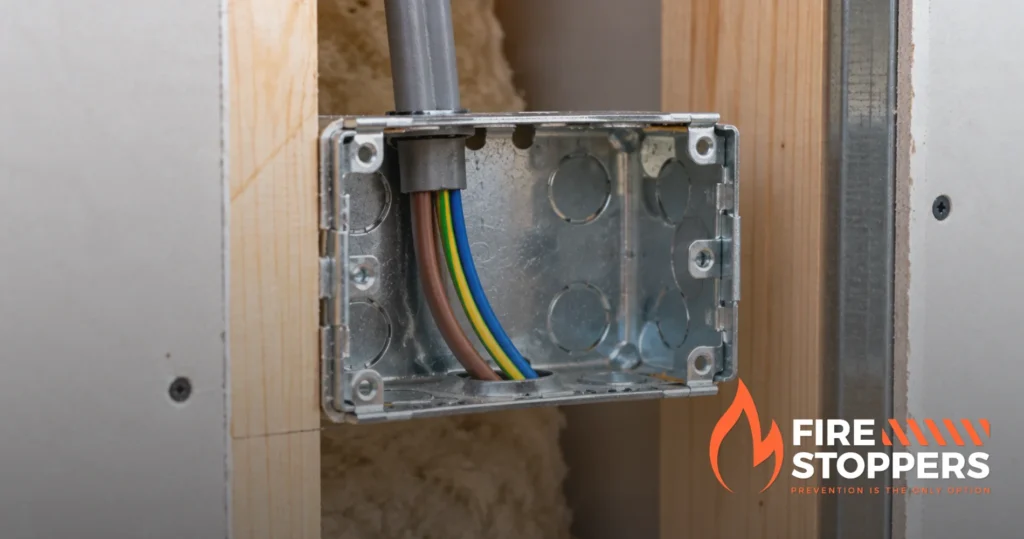
Standard electrical boxes are not. A fire-rated plasterboard partition only works as a fire barrier when the boards are continuous, and every socket box removes a section of board from one face of the wall.
In a fire, the faceplate and an unprotected plastic box burn away quickly, leaving an open recess into the cavity. Once fire and smoke are inside, they travel sideways to the next weak point on the far face, such as another socket. The wall’s fire rating is then set by its weakest socket, not its boards.
Picture a corridor wall between two apartments, rated to hold back fire for an hour. An electrician fits a standard plastic box on each side, directly opposite each other, and nothing seals either one. If a fire starts in one apartment, the box on that side gives way, heat and smoke reach the cavity, and the matching box on the corridor side is just across it. No board has been damaged, yet the route through the wall is the sockets themselves.
This is mainly a drylining problem, meaning walls built from plasterboard on a frame. A socket in solid masonry is usually a lower risk, but plasterboard fixed to masonry and hollow blockwork can still leave a route for fire, so the wall construction decides. In stud partitions and plasterboard walls between apartments, corridors and stairwells, every electrical socket is a gap in the wall until it is sealed.
The same logic applies to switches, data points, and recessed downlights in a fire-rated ceiling or floor. These are all electrical penetrations through the board, and each one needs fire-stopping to protect the building’s compartmentation, which is how it is divided into fire-resistant sections.
So the question becomes which method fits the wall in front of you.
What Is Used to Fire Stop Electrical Sockets?
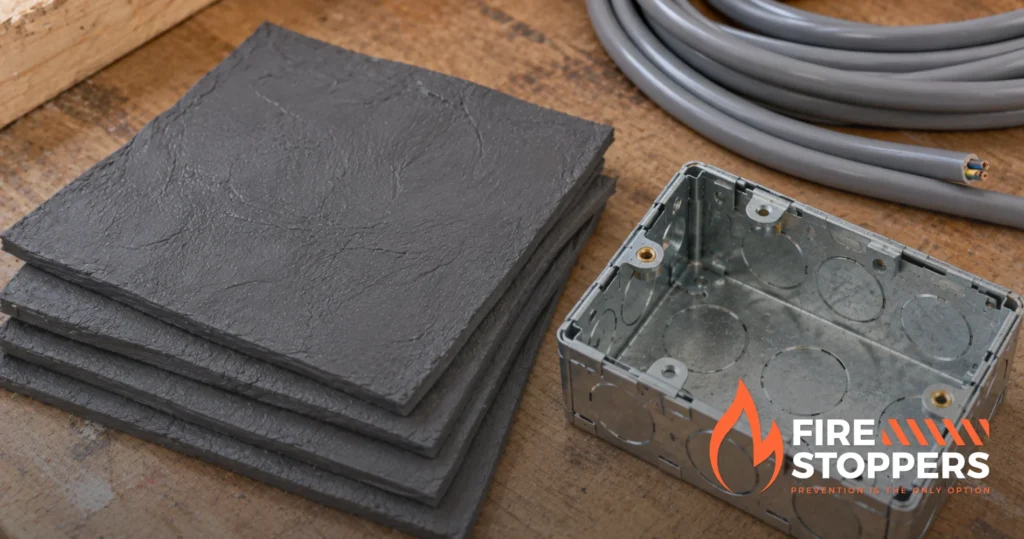
Three product types do almost all the work of fire stopping socket boxes: intumescent putty pads, pre-formed socket box inserts and fire-rated back boxes. Most rely on intumescent material, which stays stable at room temperature and expands under heat to close the opening, preventing the spread of fire and the passage of smoke through the box.
| Method | Best suited to | Watch for |
| Putty pad | Awkward cable entries, odd box sizes, retrofits | Coverage must be complete, right out to the front face |
| Socket box insert | Existing sockets of a standard size | Insert must match the box depth and gang size (single or double) |
| Fire-rated back box | New builds and full rewires | Goes in at first fix, before the boards go up, and must not be swapped on site |
Protecta, Tenmat and Envirograf all make products for electrical service penetrations, and within each range the tested wall types, box depths and fire periods differ. Two pads that look identical on the shelf can carry very different test results.
Many are sold as fire and acoustic seals, because closing the opening cuts air leakage and stops sound and air moving through the box. That acoustic performance is a bonus. Fire is the reason to fit them.
Intumescent Putty Pads
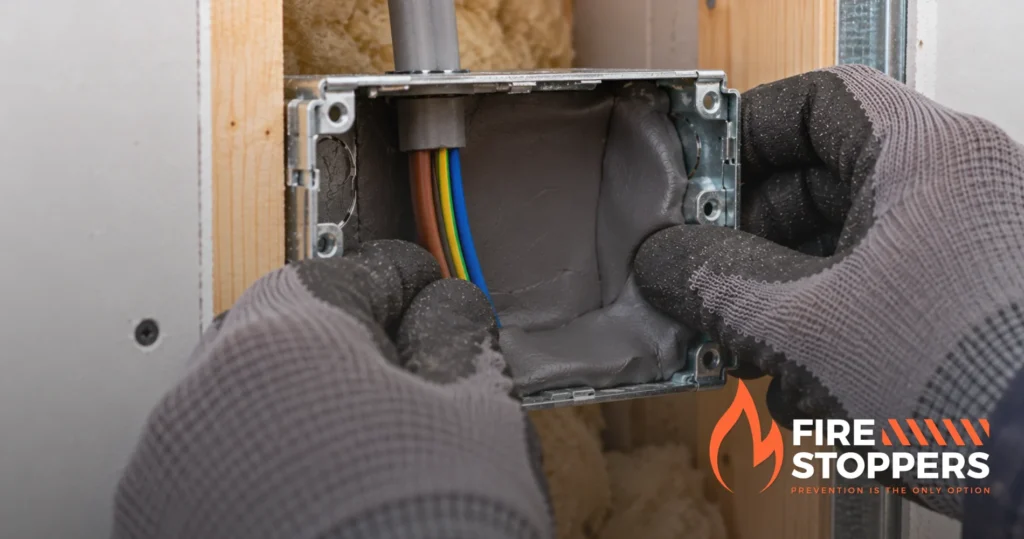
Each pad is a sheet of non-setting putty that you press into the box to line the back and sides, or wrap around the outside of the box before it goes into the wall. Because non-setting putty remains flexible, it can be moulded around cables and knockouts (the punch-out holes where cables enter the box) and reshaped if the socket is ever changed. Putty pads are designed for the situation most buildings are in: sockets already fitted, walls already finished. For the product itself and how to fit it, see our guide to putty pads for electrical sockets.
Socket Box Inserts
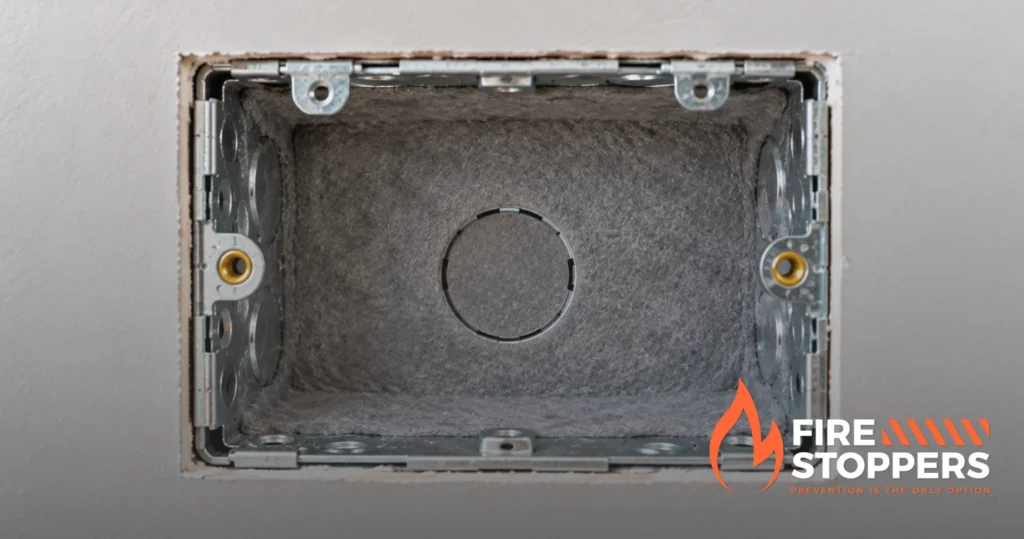
A box insert, sometimes sold as a socket box cover, is a pre-formed liner, usually made from mineral fibre, shaped to drop straight into a single or double box. In a fire, it reinstates the fire rating of the partition at that box, either by expanding or by blocking the opening, depending on the product. There is no moulding and no mess, and anyone checking the work can see at a glance that the insert is there. The trade-off is fit, because an insert made for a 35mm box will not do the job in a 47mm one.
Fire-Rated Back Boxes
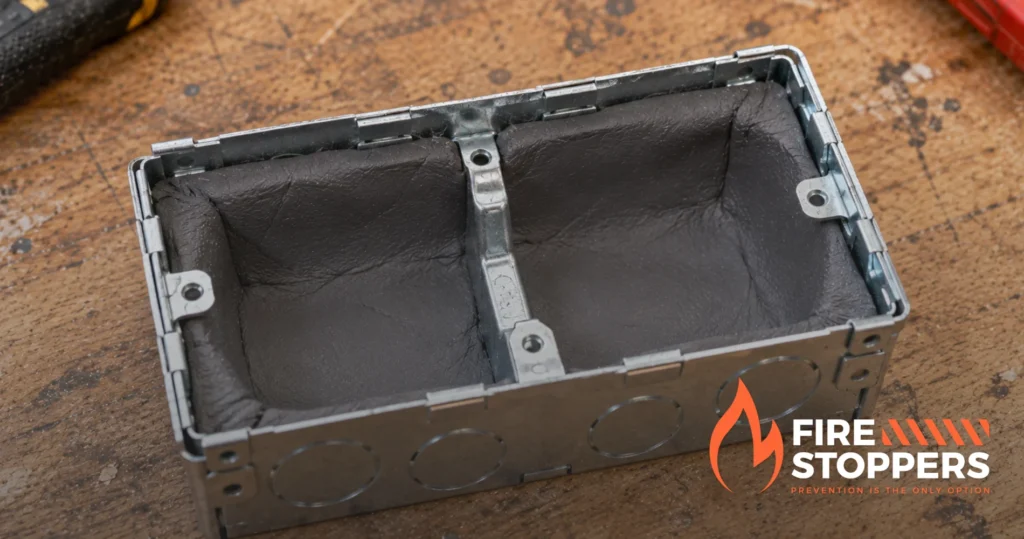
With a fire-rated back box, the protection comes built in: typically an intumescent pad bonded inside a dry lining box, usually steel. Manufacturers test them to maintain the fire resistance of gypsum walls for periods of up to 120 minutes in specified wall build-ups (the layers a wall is made of).
Which Back Boxes Are Suitable for Fire-Rated Walls?
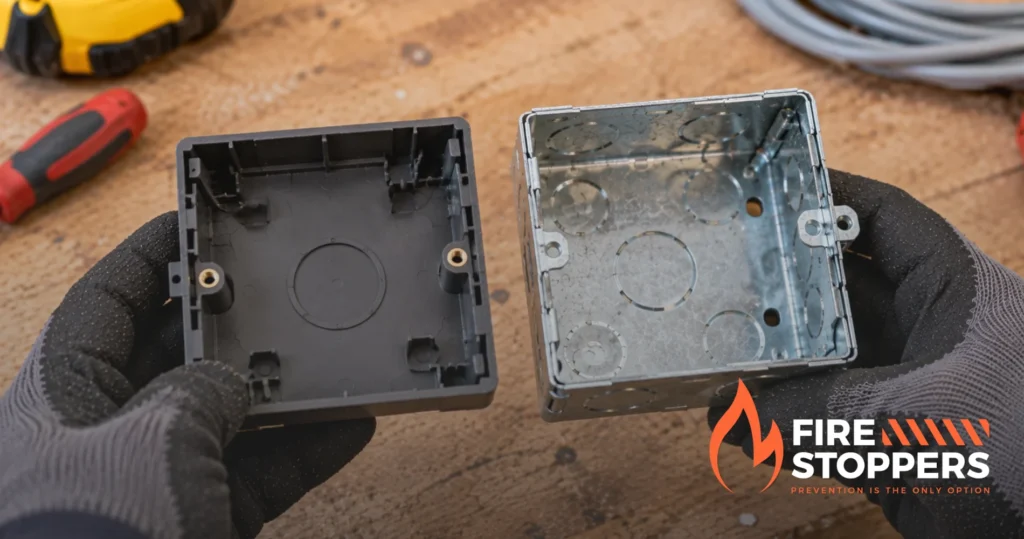
Either a fire-rated back box rated for that wall, or a standard box paired with a pad or insert proven with it. What does not work is a standard box on its own, however neatly it is fitted.
Where you control the specification, a fire-rated back box is the cleaner option. The protection arrives inside the box, so there is no separate product for someone to forget, remove or fit badly. Ranges stocked by Irish electrical wholesalers come in single and double versions at 35mm and 47mm depths, with the tested wall type stated on the product data.
Are Plastic Back Boxes Fire Rated?
Not on their own. An unprotected plastic box softens and collapses early in a fire, and what is left is an opening the full size of the box. Metal boxes hold their shape for longer, but they conduct heat into the cavity, so a bare metal box is not a fire-rated one either. Pads and inserts from the main manufacturers are generally tested on both, but check that the product data names the box type you have, because some products are tested on one and not the other.
How Do You Fire Proof an Electrical Box?
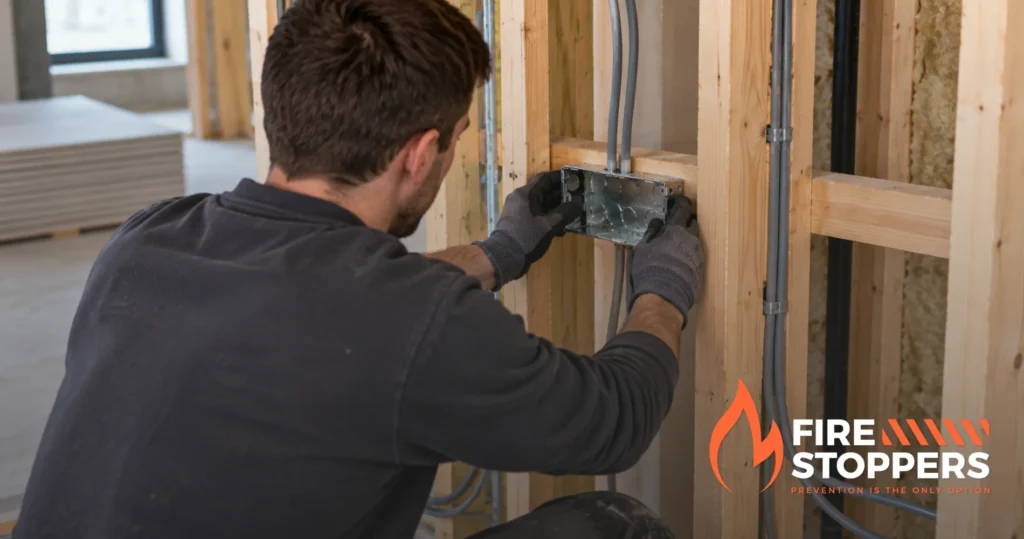
You match the method to four things: the stage of the construction project, the wall build-up, the box itself, and what sits on the other side of the wall.
Stage of the build. On a new build or full rewire, fire-rated back boxes can be specified at first fix and the problem is solved before the boards close. In a finished building the box is already in the wall, so the realistic options are a pad or an insert, fitted from the front with the faceplate off, so the wall usually stays closed and the room stays in use.
What the wall is made of. A product tested in a double-layer partition cannot be assumed to perform in a single-layer one, and a product tested for 60 minutes cannot be assumed to reach 90. The product has to match the fire rating of the wall itself, so what you need is a fully tested passive fire product, fitted exactly as tested.
The box itself. Depth, gang size, metal or plastic, and the number of cables entering it all narrow the choice. Pads are more forgiving here because they are shaped on site.
Is there a socket opposite? If so, the rules change, because not every product is tested for it.
Can Sockets Be Back to Back in a Fire-Rated Wall?
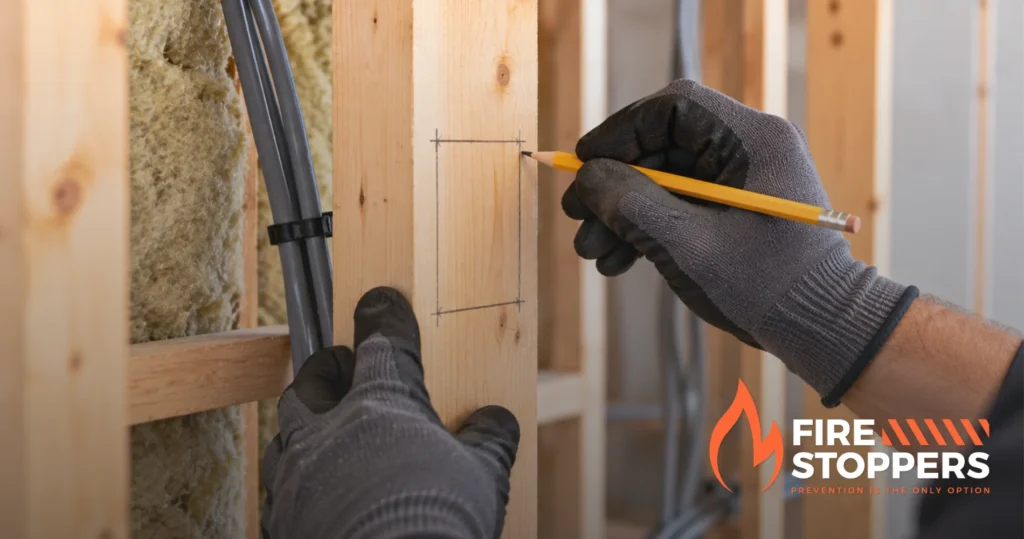
Back-to-back sockets are a higher-risk arrangement, because a fire that breaches one box has a short, direct route through the cavity to the box opposite. No single spacing rule covers every product, because each manufacturer’s own fire test sets the permitted distance.
Some products are tested at zero offset. Tenmat, for example, publishes a minimum offset of 0mm in its socket box insert datasheet, meaning boxes can sit directly back to back, provided the partition matches the tested build-up, which for those results means at least two layers of 12.5mm board on each side and a wall at least 100mm thick. Other products are only tested with the boxes offset, and some are not tested for back-to-back use at all.
Back-to-back only works as a tested system. If you are laying out sockets on opposite faces of a party wall or corridor wall, the product data must list back-to-back fitting for your exact wall build-up. If it does not, offset the boxes or choose a product that does, and settle this before first fix.
Moving a box on a drawing costs nothing. Changing product once the walls are painted costs a great deal more.
Can You Use Filler or Foam Around a Socket Box?
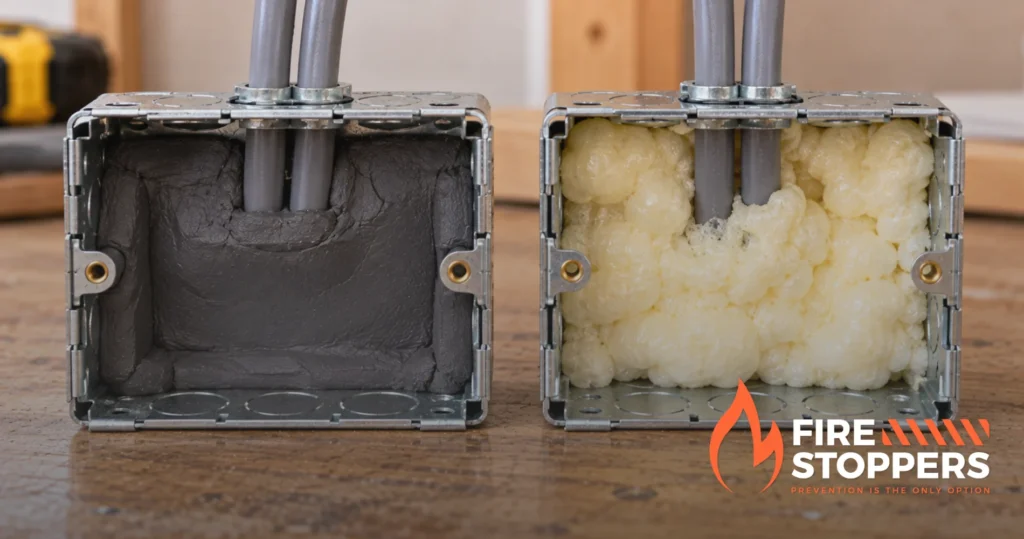
No. Polyfilla, standard expanding foam and decorator’s caulk have no fire rating, so a gap filled with them is still an open penetration as far as a fire is concerned. They make the wall look finished, and that finish is what stops anyone questioning it.
Fire-rated sealants and intumescent mastics do exist, but a bead of mastic around a socket only counts if the product data covers socket boxes in that wall type. Anything else is a guess. The same applies to cables passing through a fire-rated wall near the box, which need their own tested seal.
The other gap people try to fill is an oversized plasterboard cut-out. Socket firestopping products are typically tested on boards cut tight to the box, so a ragged cut-out wider than the product’s permitted gap falls outside the tested method. Where that happens, the board needs to be properly repaired before the socket is sealed.
Why Does Fire Stopping Around Sockets Fail?
Most failures come from what happens around the product, not from the product itself.
Standard boxes swapped in on site. The drawings call for fire-rated boxes, the van has standard ones, and the swap is never recorded. From the front of the wall, nobody can tell.
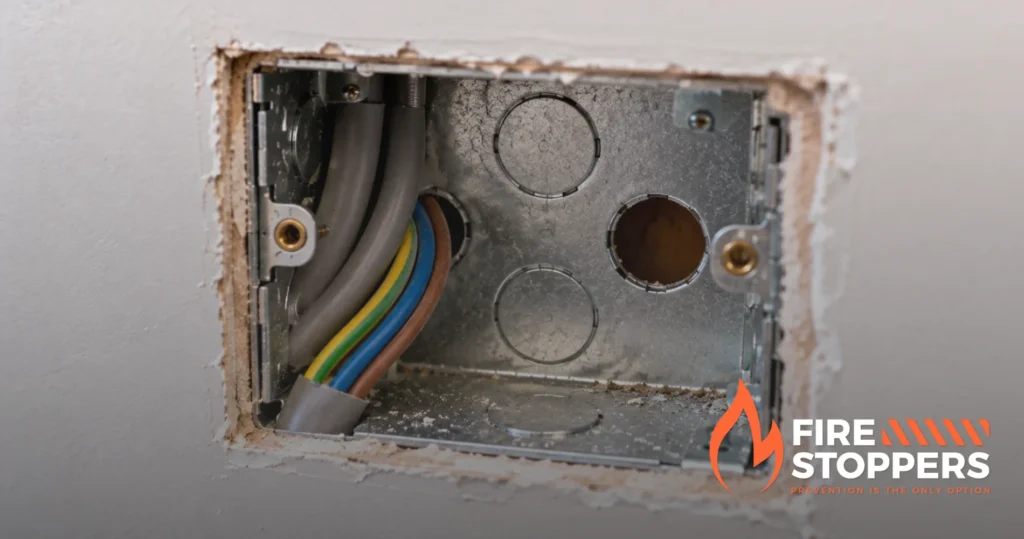
An unsealed knockout. A box can be fully lined and still leak through an unsealed knockout or a cable entry cut far larger than the cable.
Seals disturbed by later work. When a socket is swapped for a USB unit, a deeper wall box is fitted or a faceplate is changed, the pad or insert is often pulled out and never replaced. The original fire rating of that section of wall goes with it.
The right product in the wrong wall. A pad tested in one wall build-up used in another, an insert in the wrong depth of box, or two fire stopping products combined in a way neither was tested for.
Assuming someone else did it. The electrician assumes the fire stopping contractor will seal the electrical socket boxes, and the contractor assumes the electrician already has. Agreeing who seals each box before first fix closes that gap, but only if it is written into the scope of works. Then check the boxes before the faceplates go on, because that is the last moment anyone can see the seal.
Proper installation and a simple record of what went where prevent all five. Without that record, the fire safety of the building rests on assumptions, and the first person to test them is usually an auditor, an insurer or a buyer’s surveyor.
Frequently Asked Questions
How can you tell if a wall is fire-rated?
Once a wall is finished, you usually cannot tell by looking at it. The reliable sources are the building’s fire safety drawings, the as-built records, or a survey that opens a small area to check the board type and number of layers. Walls between apartments, around stairwells and along escape corridors are the most likely to be fire-rated.
Do light switches and data points need fire stopping too?
Yes, wherever they sit in a fire-rated wall. A switch box or data point cuts the same hole in the board as a socket, so the wall loses the same protection. Many products list switch and data boxes alongside sockets, so check the product data for the box you have.
Can you fire stop existing sockets without opening the wall?
A sound box can be fire stopped from the front. A putty pad or box insert for a single or double socket goes in once the faceplate is off and the power is isolated, and the plasterboard stays untouched. A damaged box, or one sitting in an oversized cut-out, needs the board repaired first.
How can you check whether sockets have been fire stopped?
Have an electrician isolate the circuit, then take the faceplate off and look inside the box. A fitted pad lines the back and sides, and an insert sits snug in the box, with the cable entries covered in both cases. A bare box suggests nothing has been fitted, although a pad wrapped around the outside of the box during the build will not show from the front. That gap is one reason a survey is more reliable than a spot check.
Can anyone install fire stopping around sockets?
Anyone can press a putty pad into a box. A competent installer goes further: they choose the product for your wall build-up, box type and spacing, and fit it exactly as the manufacturer tested it, with full coverage and no gaps at the cable entries. That choice matters because on a building with hundreds of sockets, one wrong product gets repeated at every one. If you are hiring, ask which product they plan to use and ask to see its product data for your wall.
Fire Stopping Services for Electrical Sockets in Ireland
If you manage a building with plasterboard partitions, some sockets may never have been sealed, or were sealed once and disturbed since. A survey shows which are properly fire stopped and what the rest need, and in many buildings the work can be done with the building occupied, one socket at a time.
Firestoppers carries out fire stopping surveys and installation across Ireland, in every county from Dublin to Donegal. We are passive fire protection specialists, and we supply the putty pads for sockets and fire protection products we fit, so you deal with one team from survey to sign-off.
Call 01 816 5587 and one conversation will tell you whether your building needs a survey. Or send the details through the contact form and we will come back to you within 24 hours.