Industrial plants change constantly. New process pipework is installed, cable routes are added, HVAC systems are altered and old services are removed as equipment and production requirements change.
Each of those changes has the potential to create a new penetration through a fire-rated wall or floor. If the opening is not correctly firestopped afterwards, the compartmentation designed to contain fire and smoke may no longer perform as intended.
The difficulty for facilities managers is that these problems are not always obvious.
A penetration might have been created six months ago during electrical work. It could be hidden above a ceiling, behind equipment or within a busy service area. In older facilities, nobody currently working on site may know when the opening was created or what treatment was originally installed.

At Firestoppers, we survey industrial facilities across Dublin and Ireland to identify these gaps in passive fire protection. Where remedial work is required, we can carry that out too, giving you one process from the initial survey through to completed works and documentation.
Why firestopping problems develop in industrial facilities
Across the industrial facilities our fire protection team surveys, three issues appear regularly: new service penetrations, damaged or unsuitable firestopping, and historical alterations that have never been properly documented.
New service penetrations
Industrial buildings rarely remain unchanged for long.
Maintenance teams and contractors continually install new cable routes, pipework, ductwork and other services. Sometimes an existing opening is enlarged. Sometimes an entirely new penetration is created.
If firestopping is not considered as part of that work, the contractor can finish their job while leaving the fire-rated wall or floor incomplete.
The problem may then remain unnoticed until the area is specifically inspected.
Damaged or unsuitable firestopping
Existing firestopping also needs attention.
Industrial environments can expose materials to moisture, temperature changes, chemicals, vibration and physical damage. The correct solution depends on the particular opening, the surrounding construction, the services passing through it and the conditions within the facility.
This is why simply seeing material around a pipe or cable does not necessarily tell you everything you need to know about the installation.
Undocumented alterations
Documentation can be another problem, particularly in facilities that have been operating for many years.
Services may have been rerouted repeatedly. Contractors have come and gone. Walls have been altered and equipment replaced.
Eventually, the current facilities team can be left looking at a penetration with no clear record of when it was created, what product was used or what work was carried out.
A detailed firestopping survey helps establish what is actually there now rather than relying on assumptions about previous work.
Industrial firestopping needs to suit the facility
A pharmaceutical plant and a distribution warehouse may both require passive fire protection, but the practical challenges can be very different.
That matters when surveying existing installations and specifying remedial work.
Pharmaceutical and biotech facilities
Pharmaceutical and biotech facilities can have particularly high concentrations of services passing through walls and floors. Process pipework, utilities, electrical infrastructure and ventilation systems can result in numerous penetrations within relatively small areas.
Cleanroom environments can add another layer of complexity.
Work may need to be carefully coordinated around operational areas while maintaining the standards expected within controlled environments. Detailed recording of completed work is also particularly important on these sites.
Firestoppers has experience working across pharmaceutical facilities in Ireland and understands the importance of carrying out work in a controlled, well-documented manner.
Food processing and cold storage
Food processing and cold storage facilities present a different set of conditions.
Moisture, condensation and significant temperature differences may all need to be considered when selecting an appropriate firestopping system. A solution suitable for one part of a facility may not necessarily be appropriate for another.
The environment, construction and individual penetration all need to be considered before deciding how the opening should be treated.
Distilleries, chemical facilities and manufacturing plants
Manufacturing environments can involve chemicals, cleaning products and other substances that need to be taken into account when firestopping systems are selected.
There may also be extensive pipework, electrical services and production equipment running through compartment walls and floors.
Rather than applying the same detail everywhere, each type of penetration needs to be considered in the context of where it is located and what passes through it.
Logistics hubs and distribution centres
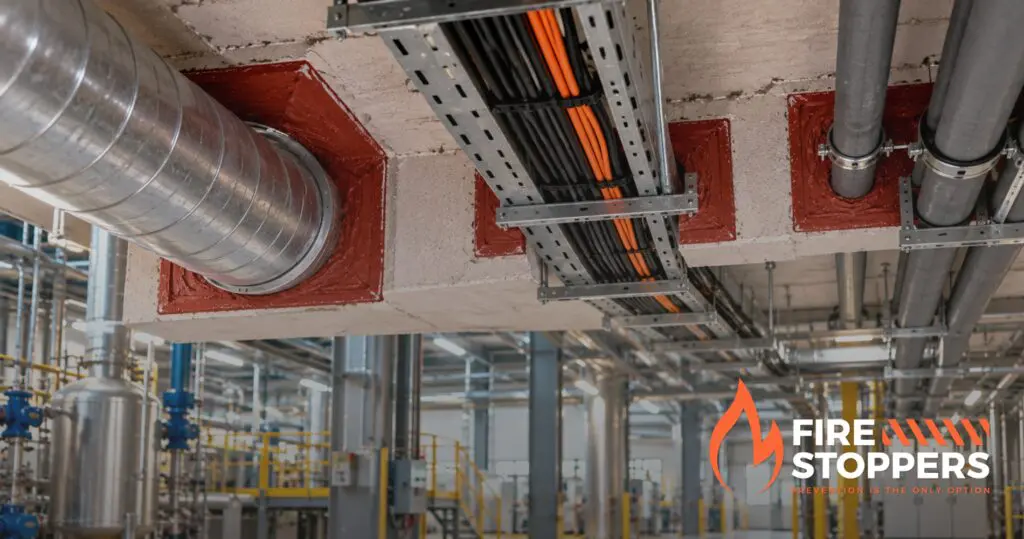
The challenge in a large warehouse or distribution centre is often scale.
Cable trays, ducts and service routes can extend across very large areas, with individual penetrations spread throughout the building. Some are immediately visible. Others can be positioned high above floor level or within busy service zones.
A systematic survey helps make sure these areas are inspected rather than relying on the most obvious penetrations being spotted during a general walkthrough.
One company carries out the survey and fixes what it finds
Firestoppers provides industrial clients across Dublin and Ireland with a complete passive fire protection service covering survey, specification, installation and documentation.
This means you do not receive a long report and then have to start looking for another contractor to complete the work.
We start with the survey
Our team inspects penetrations, joints and openings through fire-rated elements across the agreed areas of your facility.
We document what we find, including the services passing through openings and the existing firestopping treatment where present. Photographic records can also be created as part of the process.
The objective is simple: establish a clear picture of the condition of the passive fire protection within the areas surveyed.
Then we identify what needs attention
Once the survey is complete, we can turn the findings into a practical scope of remedial work.
Instead of simply receiving a list of problems, your facilities team has a clearer understanding of what needs attention and where the work is located.
Our team carries out the work
Firestoppers can then complete the required firestopping.
We know shutting down an industrial facility for passive fire protection work is rarely practical. Works can therefore be coordinated with facilities and operations teams wherever possible to reduce disruption to normal activity.
For larger sites, this may mean completing the project in planned sections rather than attempting to tackle everything at once.
You have a record of the completed work
Documentation is an important part of the process.
Depending on the project, the completed package can include photographic records, relevant product information, installation records and a completion report.
Your facilities team therefore has a clearer record of what was found, what was subsequently completed and where the work took place.
Firestopping problems are easy to miss
One of the difficulties with passive fire protection is that much of it sits quietly within the fabric of the building.
There is no warning light when a contractor drills a new cable route through a compartment wall and fails to reinstate the opening correctly. Operations continue as normal.
The same is