An intumescent collar is a metal housing packed with a heat reactive material that crushes a plastic pipe shut the moment a fire reaches it.
What’s less obvious is where a collar actually gets specified, and where a wrap or sleeve is the better fit instead.
Get that mix wrong and you either overspecify a straightforward pipe run, or use the wrong product for the pipe and the wall or floor in front of you.
How an Intumescent Collar Is Built
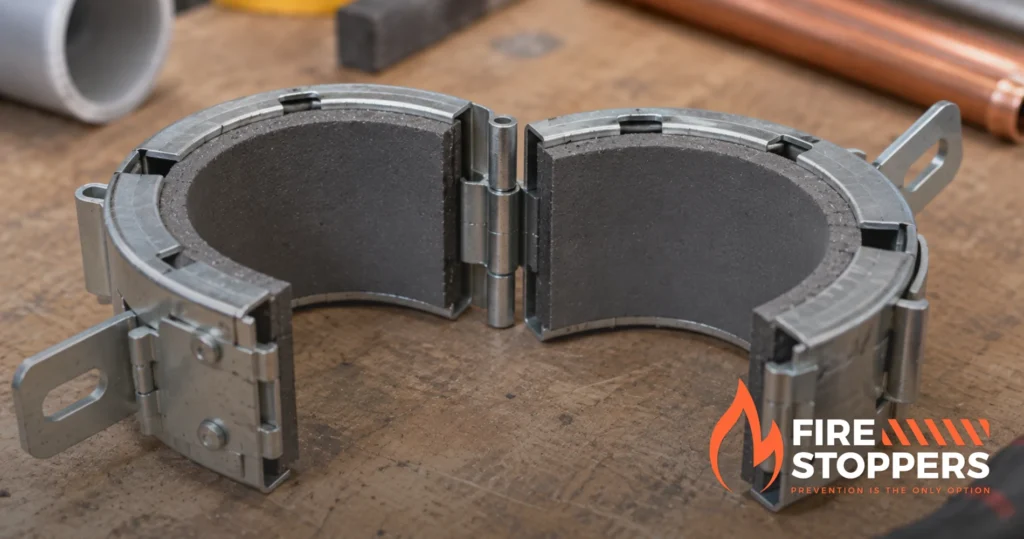
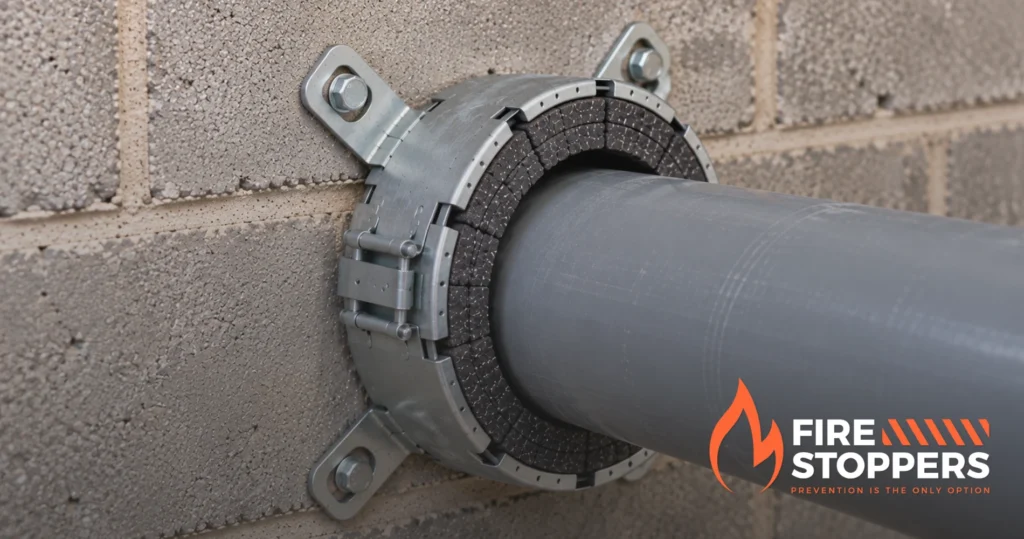
Every collar is built around the same core structure: a rigid outer housing packed with an intumescent lining, intumescent simply meaning a material that swells when heated. That housing is usually mild steel or stainless steel, fixed to the surface of a wall or floor around a pipe.
Collars come in two housing styles. A continuous band has no opening and has to be threaded onto the pipe before it’s installed, which works fine for new builds where the sequence is planned in advance.
A hinged collar with a quick release pin opens to fit around pipework that’s already in place, which is why it’s the version most often specified for retrofit work on an existing building.
Both styles do the same job once fixed. The choice comes down to sequencing: continuous for new work planned in advance, hinged wherever a contractor needs to fit around a pipe that’s already in place.
How an Intumescent Collar Works
Plastic pipework, PVC, ABS, PP and similar materials, melts long before masonry or concrete does. Once that happens, a fire has a clean, open aperture straight through what should be a sealed compartment wall.
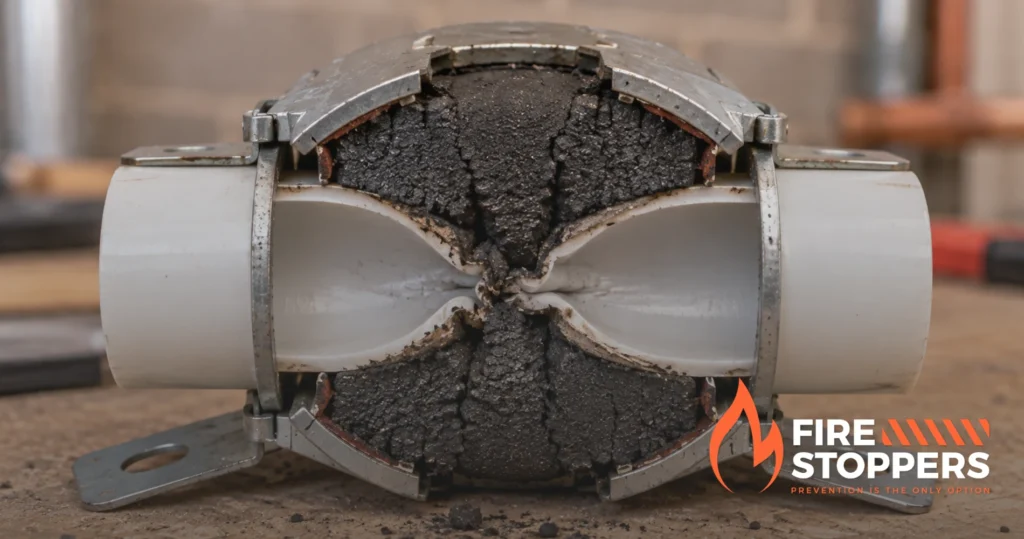
The intumescent material inside the collar is what stops that from becoming a problem. Once it’s exposed to the heat of a fire, it expands rapidly and crushes the softening pipe until the aperture closes.
The moment the pipe melts, the intumescent material has already begun expanding to fill the gap, restoring protection to the wall or floor for as long as the tested system is designed to perform.
That’s the whole mechanism. No moving parts. No power supply. Nothing to fail because a switch didn’t flip. What it actually prevents is flame, smoke and hot gases moving from one compartment into the next through the gap the pipe left behind.
Where Are Intumescent Collars Used?
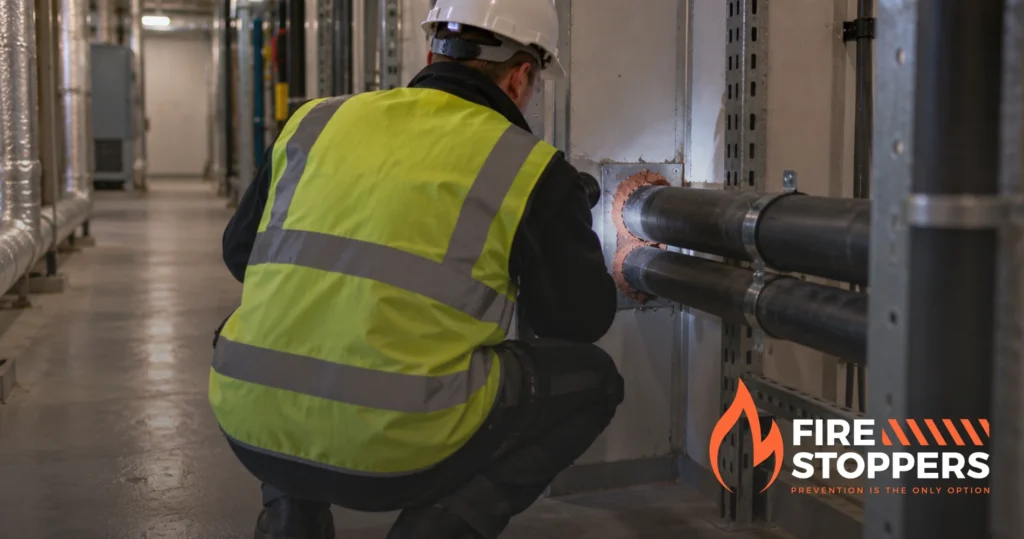
Intumescent collars are most commonly specified wherever a plastic pipe passes through a fire-rated wall or floor, in commercial buildings, residential buildings, schools, and anywhere compartmentation is part of the overall fire strategy.
They’re one of several ways of protecting a pipe penetration. Related service penetrations, cables and ducts follow a similar principle, sealing the gap a service leaves behind, though they often call for a different tested system altogether.
Whether a collar, wrap or sleeve is the right fit for a particular penetration depends on the pipe material, the diameter, the wall or floor construction, and the tested system that’s been specified for that project. A fire collar for plastic pipes is the most common starting point, but it isn’t automatically the right answer for every penetration.
A qualified fire stopping specialist can confirm the right approach for a specific site, since the same-looking penetration can call for a different product depending on what’s actually running through it.
Do Plastic Pipes Need Fire Collars?
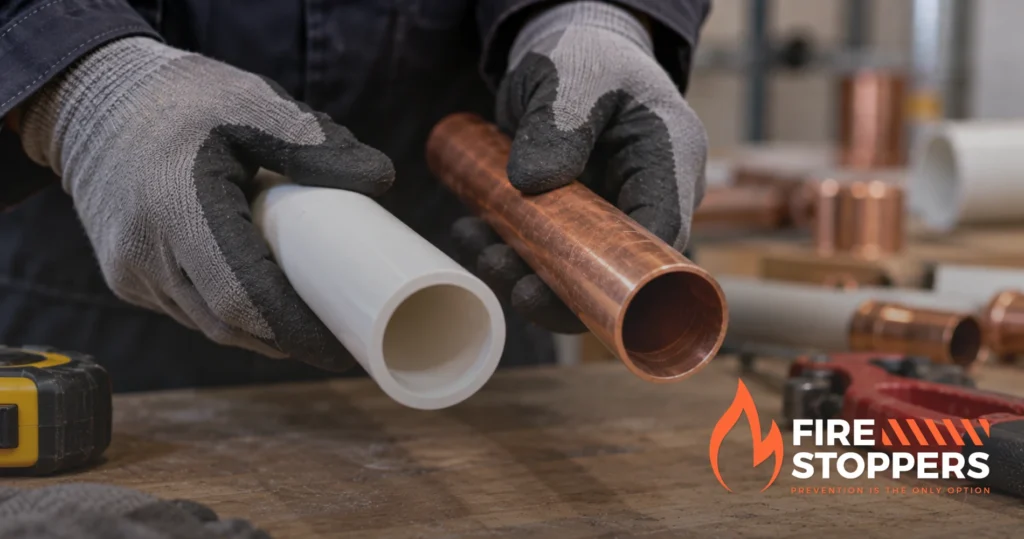
Not every pipe calls for a collar. The pipe material is usually what decides it.
Combustible pipes, PVC, ABS, MDPE, HDPE and polypropylene (PP), soften and eventually melt in a fire. Left unsealed, that melting pipe becomes the hole a fire spreads through.
These are the pipe materials an intumescent pipe collar is built for.
Metal pipes behave differently. Copper, steel and cast iron don’t melt the same way plastic does, so they’re less commonly protected with a standard fire collar. Depending on the system specified, metal pipe penetrations may instead use fire rated mortar, mineral wool packing, an intumescent coat, or in some cases an insulated fire sleeve.
Pipe material, diameter, the wall or floor construction and the tested system being used all need confirming before a collar is specified, usually by the project’s specifier rather than decided on site.
What Size Intumescent Collar Do You Need?
Collar sizing follows the pipe’s outside diameter, and varies by pipe material as much as by diameter, there’s no fixed standard across products. Ranges typically span smaller 30mm and 40mm waste pipes up to 100mm, 125mm and 200mm soil pipes, with heavier duty options available for larger industrial pipework.
Fire rating scales with size and application too. A collar rated for a smaller diameter pipe and the same collar rated for a larger one aren’t necessarily built the same way inside, even if the casing looks identical.
All these products are tested to specific standards before they’re rated, which is why the test certification matters more than the label. A collar’s tested performance on one diameter and substrate doesn’t automatically carry over to a different one.
The intumescent lining itself is only a few millimetres thick when cold, which is part of why it needs to expand so dramatically once it’s exposed to fire.
Getting the size wrong in either direction causes real problems. Too small and the collar can’t fully crush the aperture shut. Too large and you’ve left a gap the intumescent material was never designed to fill.
Fire Collar vs Pipe Wrap vs Fire Sleeve
Intumescent collars aren’t the only option on the market, and the terms get used loosely enough that precision matters.
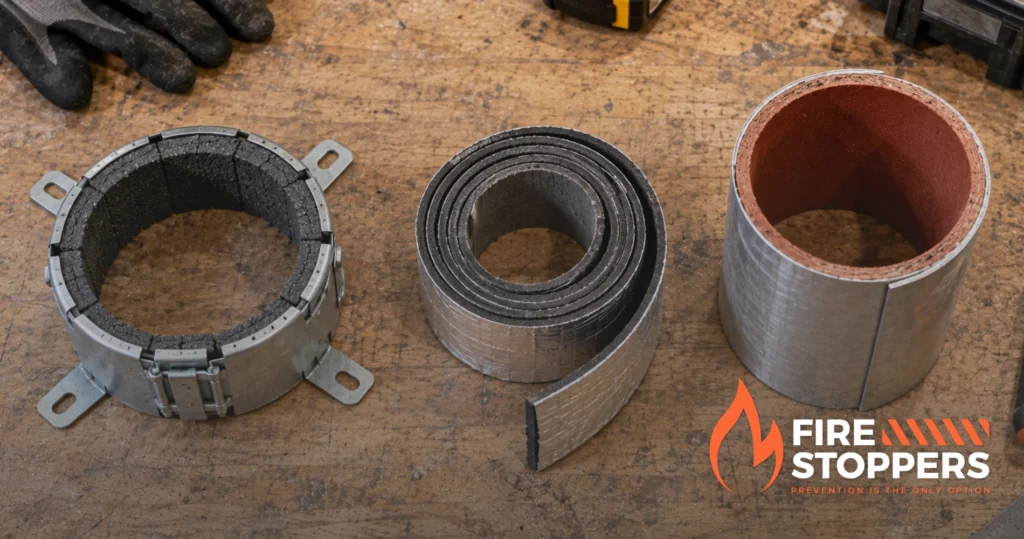
Pipe wraps do the same job as a collar, crushing a melting pipe shut, but instead of a rigid metal housing, it’s a flexible intumescent strip wound around the pipe. Wraps suit tight service voids where a bulky collar won’t fit, and they’re a common retrofit option where fire stopping wasn’t specified before the pipe went in.
An insulated fire sleeve is a different product again, built to handle both plastic and metal pipe penetrations. It uses a mineral wool style insulation core alongside intumescent material and is inserted directly into the penetration rather than fixed to the surface like a collar.
For continuous fire and smoke protection on a mixed pipe run, a sleeve is often the right fire collar alternative to specify, not a straightforward collar. Getting the configuration right, collar, wrap or sleeve, depends on the pipe run and the substrate it’s fixed into: masonry, plasterboard or a concrete floor, not personal preference.
| Intumescent Collar | Pipe Wrap | Insulated Fire Sleeve | |
|---|---|---|---|
| Construction | Rigid metal housing, intumescent lining | Flexible intumescent strip | Insulation core with intumescent material |
| Typical pipe type | Plastic pipe penetrations | Plastic pipe penetrations, tight voids | Plastic and metal pipe penetrations |
| Fitting | Fixed to the surface around the pipe | Wound around the pipe | Inserted directly into the penetration |
| Common use case | Standard new-build pipe penetrations | Retrofit or restricted spaces | Mixed pipe runs needing continuous protection |
Which one is right for a given penetration depends on the pipe, the wall or floor, and the tested system specified for that project.
How Do You Install an Intumescent Collar?
How a collar is installed matters as much as which one is chosen. It needs to be fitted according to the system’s tested specification, using a substrate suited to the fixings provided and with any gap around the collar properly addressed.
A collar’s rating is only as good as its fitting. Get the installation wrong and even a correctly specified, properly tested product performs like it was never tested.
An experienced contractor is what makes that system hold together. Passive fire protection only works as a system: the collar, the wall it’s fitted to, and the workmanship holding it together.
Miss one part and the fire and smoke barrier the compartment depends on has a weak point nobody notices until it’s tested for real.
If you’re working out whether a penetration needs a collar, a wrap or a sleeve, that’s worth getting checked before the works are priced, not after. Get in touch with Firestoppers for a fire safety assessment and we’ll confirm the right system for your project before anything’s specified.