Most people think about fire safety in terms of smoke alarms and escape plans. Both matter. But there’s a weak point in almost every Irish home that tends to get overlooked completely, and it’s staring you in the face from the moment you walk into any room.
Your windows.
Window protection for fire safety is one of the least understood areas of passive fire protection. Standard glass can crack and collapse within minutes of fire exposure. When that happens, the fire doesn’t just escape through the gap, it accelerates. In this article, you’ll learn exactly how fire-rated glazing works, when Irish building regulations require it, and what it realistically costs to get it done properly.
Why Windows Are a Serious Fire Risk in Your Home
Standard float glass fails fast. At around 150 to 200 degrees Celsius, it cracks. At 300 degrees, it’s likely falling out of the frame entirely. That might sound like a temperature that takes a long time to reach, but in a well-developed room fire, you’re talking about two to four minutes.
When the glass goes, you lose the compartment. Fire, smoke, and toxic gases flood through the opening. The structural integrity of the room collapses far faster than if that barrier had held.
In terraced housing, semi-detached homes, and apartments, this becomes even more critical. Fire spreading between properties through failed window assemblies is a real and documented cause of loss of life. It’s not a theoretical risk.
What Fire-Rated Glass Actually Is
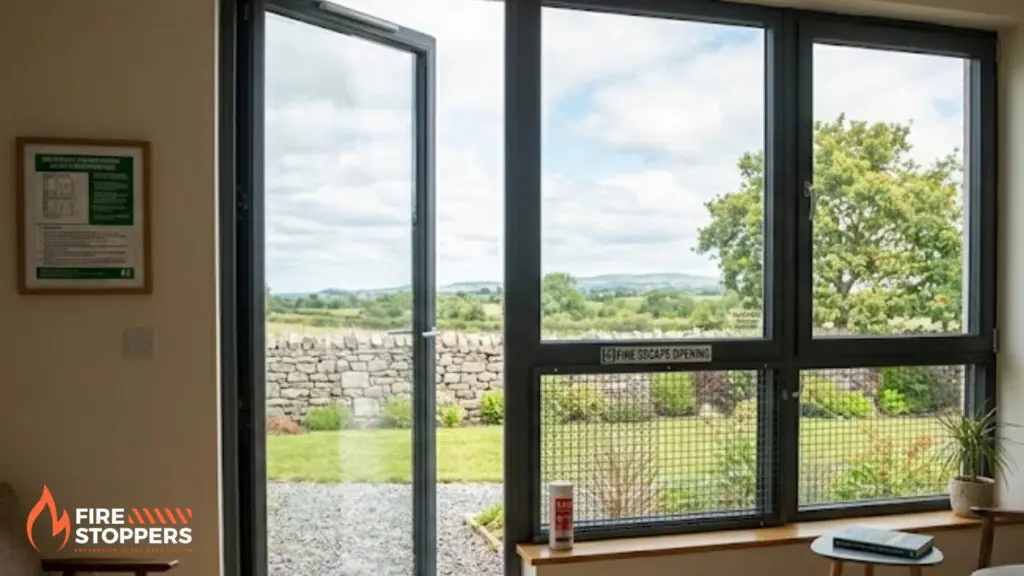
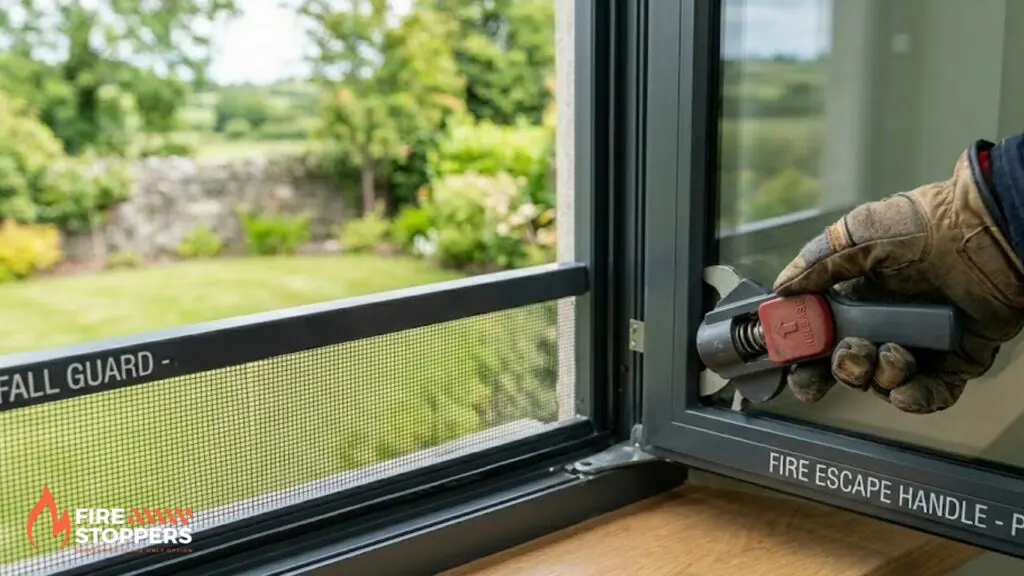
Fire-rated glass isn’t just toughened glass with a sticker. It’s a specifically engineered product tested to European standards and given a classification based on how long it performs.
The two classifications you’ll most often see are E and EI.
E-rated glass (integrity-only) is rated to resist the passage of flames and smoke for the stated duration under test conditions. It does not, however, stop heat from radiating through the pane. Stand close enough to an E30-rated window during a fire on the other side and you’ll still feel serious radiant heat. It buys time. It doesn’t eliminate all risk.
EI-rated glass (integrity plus insulation) does both. It limits flame and smoke transfer and significantly reduces heat radiation. EI-rated glass is used in situations where people might be close to the glazed surface during an evacuation, or where the glass forms part of a fire door or escape corridor.
Both come in rated durations. E30 or EI30 means 30 minutes of protection under test conditions. E60 and EI60 give you an hour. E90 and EI90 give you 90 minutes. The rating you need depends on your building’s fire strategy and what the glazing is doing within that strategy.
Window Protection for Fire Safety Under Irish Building Regulations
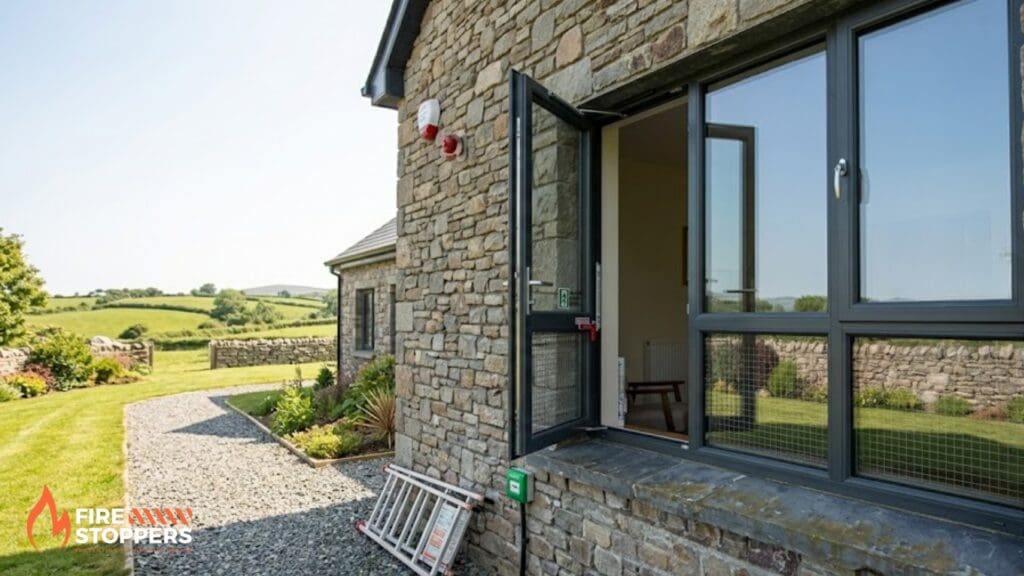
In Ireland, fire safety in buildings is governed by Technical Guidance Document B (TGD Part B), which covers all residential construction. If you’re building a new house, extending an existing one, or converting a space, fire protection requirements are part of the compliance package.
The most common situations where window protection for fire safety becomes mandatory are:
Any window within one metre of a property boundary needs to meet specific fire resistance criteria. This catches a lot of people off guard during extension projects, particularly the popular side-return extensions in Dublin that push right up to the boundary line.
Fire doors and internal fire-rated windows within apartments or multi-unit dwellings must meet EI ratings, as they form part of the fire compartmentation strategy for the building.
Windows in protected stairways, escape routes, and fire-resisting corridors must be fire-rated because these are the paths people use to get out.
For existing homes, there’s no automatic retrofit requirement unless you’re carrying out work that triggers a building regulation application. But if you’re doing an extension, attic conversion, or change of use, it’s worth getting a fire safety assessment done properly from the start. Retrofitting fire-rated glass after the fact is always more expensive than specifying it correctly at design stage.
The Intumescent Seal: The Detail That Makes or Breaks the Assembly
Here’s something most homeowners don’t realise. Fire-rated glass is only part of the picture. The frame it sits in, and the seal between the glass and the frame, matters just as much.
Standard window frames expand and warp under heat. Gaps open up. Fire and smoke bypass the glass entirely and travel through the frame junction or around the edge of the pane. All that expensive fire-rated glass becomes pointless if the assembly around it hasn’t been designed and installed to the same standard.
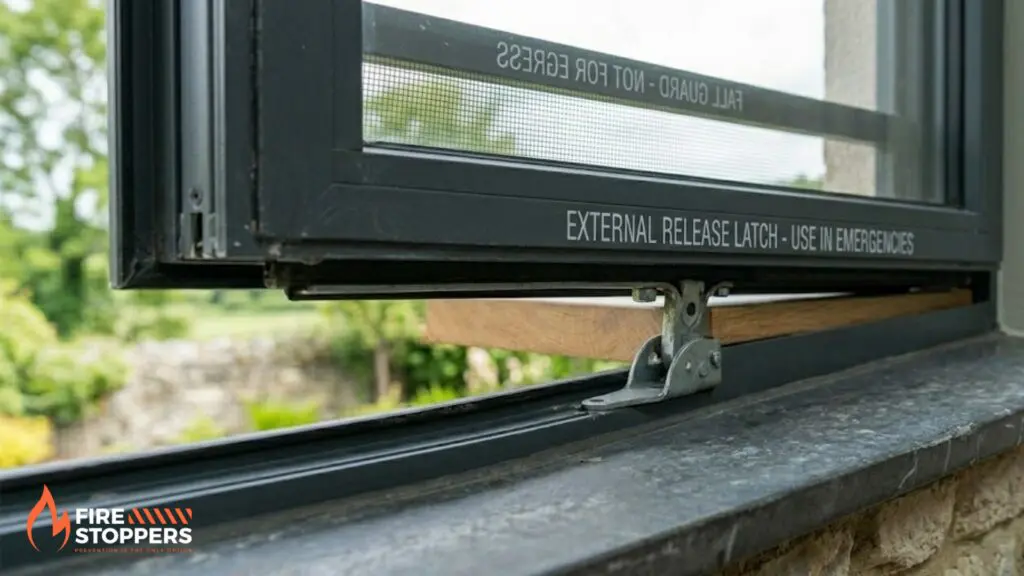
Intumescent seals sit within the rebate of a fire-rated frame. When they reach a temperature of around 150 to 200 degrees Celsius, they expand rapidly, sometimes to ten times their original volume. That expansion is designed to close gaps and help maintain the integrity of the assembly.
Without intumescent sealing, a window with fire-rated glass can still fail its rated period simply because the seal couldn’t keep up with the frame movement. This is why passive fire protection in windows is always an assembly question, never just a glazing question.
How Much Does Fire-Rated Glazing Cost in Ireland?
Prices vary significantly depending on the type of glass, the frame specification, and the size of the opening.
For E-rated (integrity-only) fire glass, expect to pay roughly €150 to €350 per square metre for the glazing unit alone. EI-rated insulating glass runs higher, typically €300 to €650 per square metre, because the laminated structure is considerably more complex.
A full window unit with fire-rated glass and a properly specified frame sits in the range of €800 to €2,500 depending on size, frame material, and rating duration required. Steel-framed fire-rated windows tend to cost more than timber equivalents, but they hold up to higher temperatures and are often used in commercial applications or high-risk residential settings.
Professional installation on top of materials adds cost, but you shouldn’t skip it. Fire-rated assemblies are only valid when installed by someone who understands the tested configuration. An incorrectly installed fire-rated window has no guarantee of performing to its rating.
For comparison, a standard uPVC double-glazed window unit in Ireland runs between €400 and €1,000 installed. Fire-rated upgrading adds roughly 40 to 80 percent to that cost depending on specification. It’s not a trivial expense, but it’s one that genuinely protects both the building and the people inside it.
When You Actually Need to Think About This
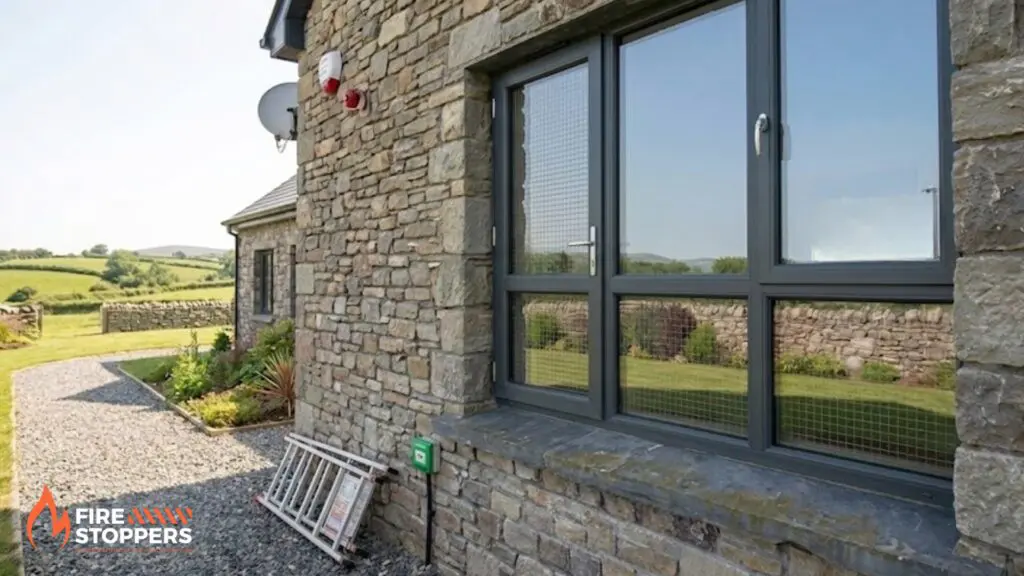
A lot of homeowners read about fire-rated glass and assume it’s only relevant for commercial buildings or apartment blocks. It’s not.
If you live in a terrace or semi-detached home in Dublin, Cork, Limerick, or anywhere else in Ireland, your property is connected to or very close to your neighbour’s. Any fire that breaks through your external wall or glazing within one metre of the boundary can spread to their property within minutes.
Extensions that include a glazed wall or rooflight near the boundary are the most common compliance flashpoint. A beautifully designed kitchen extension with a full-height glazed side wall sounds great until a fire surveyor flags that the glazing doesn’t meet TGD Part B and the local authority building control officer sends back the compliance certificate.
Apartment blocks built before 2001 are another area of concern. Many older apartment buildings in Irish cities were built under earlier standards, and glazed elements in common areas, stairwells, and flat entrance doors often fall short of modern expectations. If you’re buying or managing an apartment, a passive fire protection survey is worth doing.
New build homes must comply with TGD Part B at construction stage, but self-builds and private contracts don’t always get the scrutiny they should. If you’re building your own home and your architect or builder hasn’t specifically flagged fire-rated glazing requirements, ask the question directly.
Choosing the Right Passive Fire Protection Installer
The glazing product is only as good as the company installing it. Ireland has a relatively small pool of certified passive fire protection specialists, and not all contractors who fit windows understand fire-rated assembly requirements.
Look for companies that hold certification from recognised bodies such as the Association for Specialist Fire Protection (ASFP). ASFP membership means the company is operating to industry standards, keeping up with product and regulation changes, and has the training to back up what they’re selling.
Ask the installer specifically which tested configuration they’re using. Every fire-rated window assembly should be installed in line with a tested and certified configuration from the manufacturer. If the installer can’t reference the product test evidence or doesn’t mention it, that’s a concern.
Firestoppers, based in Santry, Dublin, have been working in passive fire protection for over 20 years and hold advanced ASFP certifications. Their team carries out fire protection assessments across residential and commercial properties throughout Ireland and can advise on window fire protection requirements as part of a broader fire safety strategy for your building.
Frequently Asked Questions About Window Fire Protection
Does my existing home need fire-rated windows?
Not automatically. If you’re not carrying out notifiable building works, you won’t trigger a compliance requirement. But if you’re extending, converting, or changing the use of a space, the project brings current regulations into play and fire-rated glazing may well be required depending on the proximity to boundaries and escape route configuration.
Is fire-rated glass the same as toughened glass?
No. Toughened glass is stronger than standard glass and shatters into small granules rather than sharp shards, but it has no meaningful fire resistance. It will still fail in a fire. Fire-rated glass is a separate, tested product category.
How long does fire-rated glazing last?
A properly installed fire-rated window assembly doesn’t have a fixed service life in the same way a smoke alarm battery does. It should be inspected periodically, however, to check for damage, seal integrity, and frame condition. Any damage to the glass or the intumescent seal should be assessed by a passive fire protection specialist before relying on the assembly.
Can any glazier fit fire-rated glass?
Technically, yes. In practice, only a specialist with knowledge of tested configurations should be doing it. The product requires correct installation to perform to its certification, and a standard glazier may not understand the specific rebate depth, frame specification, and seal requirements for the product they’re fitting.
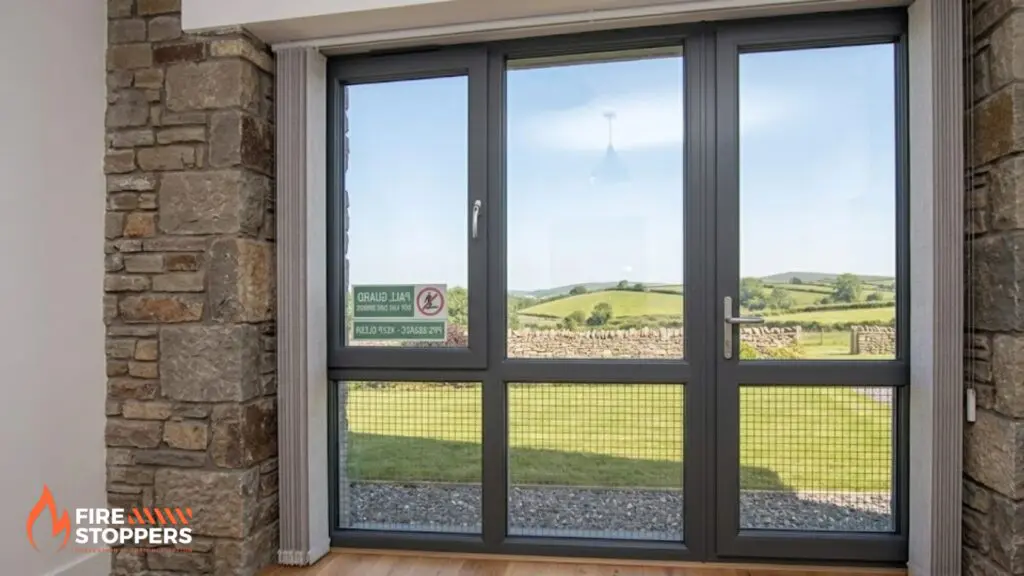
The Bottom Line on Window Protection for Fire Safety
Window protection for fire safety is one of those topics that most homeowners never think about until something prompts the question, whether that’s a building control query, a fire safety survey, or an extension project. The good news is that the solutions are well-established, tested, and available in Ireland.
The key thing to take away is that it’s an assembly, not just a product. Fire-rated glass in the wrong frame with the wrong seal is a false sense of security. Get it specified and installed properly, and you have a properly specified and installed assembly that is rated to perform for 30, 60, or 90 minutes under standard test conditions.
If you’re planning an extension near a boundary, managing an older apartment block, or just want to understand what protection your building actually has, talk to Firestoppers. Their team can carry out a fire safety assessment and tell you exactly where you stand under current Irish regulations.