Firestoppers carries out professional fire risk assessments for commercial premises, apartment blocks, and managed properties across Dublin and Ireland. Where your assessment identifies passive fire protection deficiencies, our team remediates them directly. One assessment. One contractor. One sign-off
What is a fire risk assessment?
A fire risk assessment is a structured review of your premises to identify potential fire hazards, evaluate the fire risks to people in the building, and set out the actions required to reduce those risks on an ongoing basis.
A professional assessment covers:
| Ignition sources and flammable or combustible materials present in the building | People at risk, including staff, visitors, and any vulnerable building users | The condition and adequacy of fire alarm systems, detection, and emergency lighting |
| Means of escape: whether fire exits are clear, accessible, and correctly signed | Passive fire protection measures: compartmentation, fire doors, and penetration sealing | Existing fire safety measures and fire safety management practices |
The output is a written report. It tells you where you comply, where you do not, and what needs to change.
Who needs a fire risk assessment?
Any non-domestic premises where people work, gather, or reside. In practice, that means:
Commercial properties. Offices, warehouses, retail units, industrial facilities, hospitality premises, and healthcare buildings all require a current assessment to ensure the safety of everyone on site.
Apartment blocks and multi-unit residential developments. The building owner or management company holds the duty of care for common areas. An assessment covering corridors, stairwells, plant rooms, and shared facilities is mandatory, not an optional add-on.
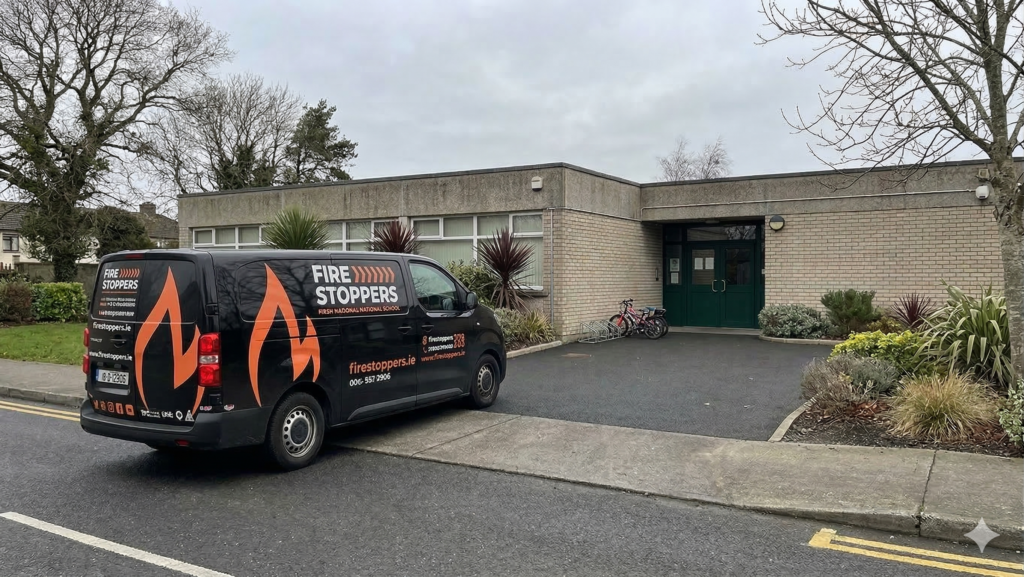
Schools and education facilities. The board of management is the responsible person and carries the statutory obligation.
Mixed-use and managed properties. If you are a property manager or facilities manager overseeing a building used by multiple tenants, the duty of care sits with you for any area outside individual tenant control.
If you are unsure whether your building requires a formal assessment, the short answer is: it almost certainly does. Contact our team and we will confirm within the day.
What does a Firestoppers fire risk assessment include?
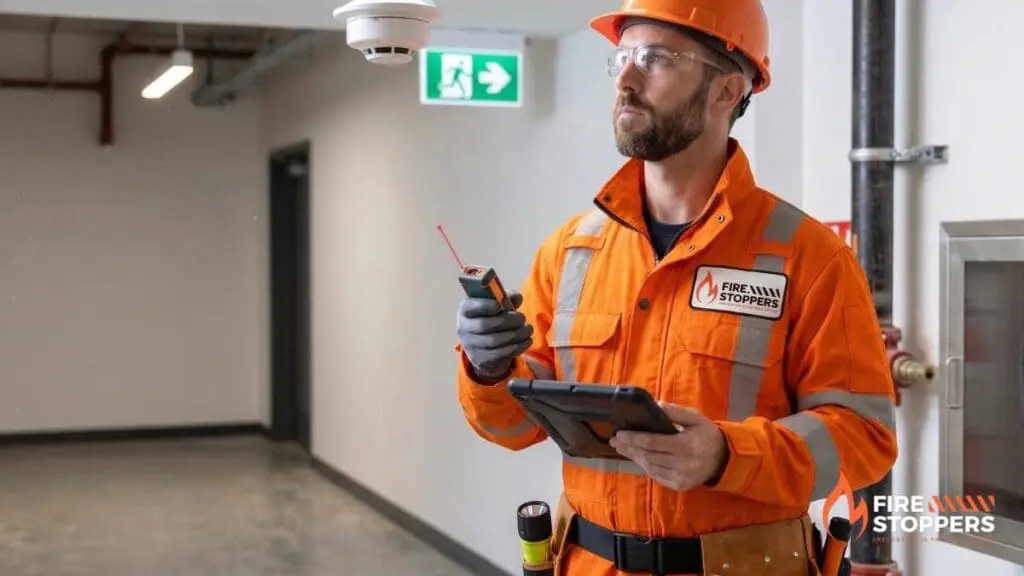
Most risk assessors hand you a list of problems and leave you to solve them. Our assessors are passive fire protection specialists. That means if your assessment uncovers compartmentation breaches, deteriorated fire doors, or unsealed penetrations, we carry out the remediation work directly. The same team that found the problem fixes it.
A Firestoppers fire risk assessment includes the following:
Site inspection. A thorough walkthrough of all areas, including roof voids, plant rooms, electrical riser cupboards, and any areas where fire stopping has been disturbed by maintenance or refurbishment works.
Hazard identification. Ignition sources, combustible materials in storage, and any building fabric or layout issues that increase fire spread risk.
Compartmentation check. We assess whether fire and smoke barriers between areas of your building are intact and compliant with TGD-B (Technical Guidance Document B), the Irish building regulation governing fire safety in new and existing buildings.
Escape route assessment. Whether means of escape are adequate, accessible, and correctly maintained, including fire exits, signage, and emergency lighting.
Active system review. A check of fire alarm systems, detection equipment, emergency lighting, and fire extinguisher provision against current fire safety regulations.
Fire procedures and staff training review. We check whether emergency procedures are documented, whether fire drills are being conducted at appropriate intervals, and whether training records are current.
Written report. A clear, prioritised fire risk assessment report stating what is compliant, what is not, what action is required, and in what order.
Fire risk assessment vs fire safety audit: what is the difference?

These terms are used interchangeably in the market, but they are not the same exercise.
A fire risk assessment is a baseline review of your building’s fire hazards, those at risk within it, the fire precautions your building relies on, and the overall effectiveness of your fire safety approach. It is the foundational legal document required under fire safety legislation. Think of it as a full picture of your current position.
A fire safety audit is a more targeted compliance check, typically used to verify that previously identified actions have been completed or to assess a specific area of concern. Audits are often carried out annually once an initial assessment has established the baseline.
Most buildings that have not had a recent formal assessment need a full fire risk assessment first. Once that foundation is in place, a lighter annual audit maintains compliance from year to year.
What happens after your fire risk assessment?
Most fire risk assessment providers hand you a report and leave. If the report identifies passive fire protection deficiencies, you then have to find a separate contractor to address them, manage that engagement, and arrange a further sign-off.
With Firestoppers, that step does not exist.
Our assessors carry out the remediation work directly. You receive a single scope of work, a single contractor, and a single compliance certificate.
For property managers and facilities teams responsible for multiple buildings, this matters. It removes the coordination overhead and significantly reduces the time between assessment and compliant sign-off.
How often does a fire risk assessment need to be reviewed?
Annual review is the standard. The HSA requires your assessment to be kept current, which means reviewing and updating it whenever circumstances change. Keeping fire safety documentation under regular review is part of your ongoing legal obligation.
You should update your fire risk assessment following any significant changes to the building, including:
| Changes to building layout, use, or occupancy | New equipment, processes, or fire risks introduced to the premises | A fire incident or near miss on the premises | Maintenance or refurbishment works that may have disturbed fire stopping | A substantial increase in the number of building users |
Even with no changes, an assessment older than 12 months is likely to be challenged during a Dublin Fire Brigade inspection. Keeping it current is not a bureaucratic habit. It is the difference between a passing inspection and a formal enforcement notice.
What does non-compliance actually cost?
This is the question most assessors do not answer directly. Here it is plainly.
Dublin Fire Brigade holds statutory enforcement powers to issue fire safety notices requiring immediate remedial action. Failure to comply can result in prohibition notices preventing occupation of the building, prosecution, and fines.
Your building insurer may also decline a claim if a fire occurs and no valid assessment was in place at the time. If you are selling or refinancing a commercial property, solicitors and due diligence teams now routinely request fire safety documentation. An absent or outdated assessment delays transactions and, in some cases, kills them.
The cost of a professional fire risk assessment is a fraction of any of those consequences. If cost is a concern, the right question is not whether you can afford one. It is whether you can afford to be without one.
What affects the cost of a fire risk assessment in Dublin?

Every premise is different, and so is every assessment. The main factors are:
Building size. Floor area and the number of distinct areas that require inspection.
Building type and use. A single-use commercial office requires a different scope to a mixed-use residential-over-retail development or a healthcare facility.
Number of building users. Higher occupancy increases the complexity of the means of escape analysis.
Condition of existing records. If previous assessments exist, the scope may be more focused. If none exist, a full baseline assessment is required.
Passive fire protection scope. If the building has a history of works that may have disturbed fire stopping, a more detailed compartmentation check is included.
We provide a fixed fee for each assessment following a brief preliminary conversation. No open-ended day rates.
Fire risk assessments across Dublin and Ireland
Firestoppers carries out fire risk assessments across Dublin city and county and nationwide. Recent assessment work has covered properties in Cork, Limerick, Wexford, Kilkenny, Wicklow, Donegal, Meath, Mayo, Fingal, and Kildare.
If your building is in Ireland, our team can reach it.
Get your fire risk assessment sorted
Understanding the fire risks specific to your building and acting on them is the difference between a compliant property and a personal liability. The longer an assessment is deferred, the narrower the gap between a compliance issue and an enforcement action.
Call our team on 01 816 5587, Monday to Saturday, to discuss your building and get a fixed-fee quote. Or complete the contact form below, and a consultant will respond within one business day.