
Fire-rated sealants, mastics and foams for fire stopping fill the gaps and joints in fire-rated walls and floors so flames, smoke and hot gases can’t pass through for the time they are rated to hold.
But a fire rating belongs to a tested installation, and the tube is only one part of it.
The same cartridge that holds a joint for up to 4 hours in one set-up can fail in a gap it was never tested for, and the finished bead looks identical either way.
Most mistakes happen before the gun comes out. A pipe run goes through a corridor wall and someone fills the gap with whichever tube is on the van. Nobody finds out it was the wrong product, or half the right depth, until it matters.
What Are Fire-Rated Sealants, Mastics and Foams for Fire Stopping?
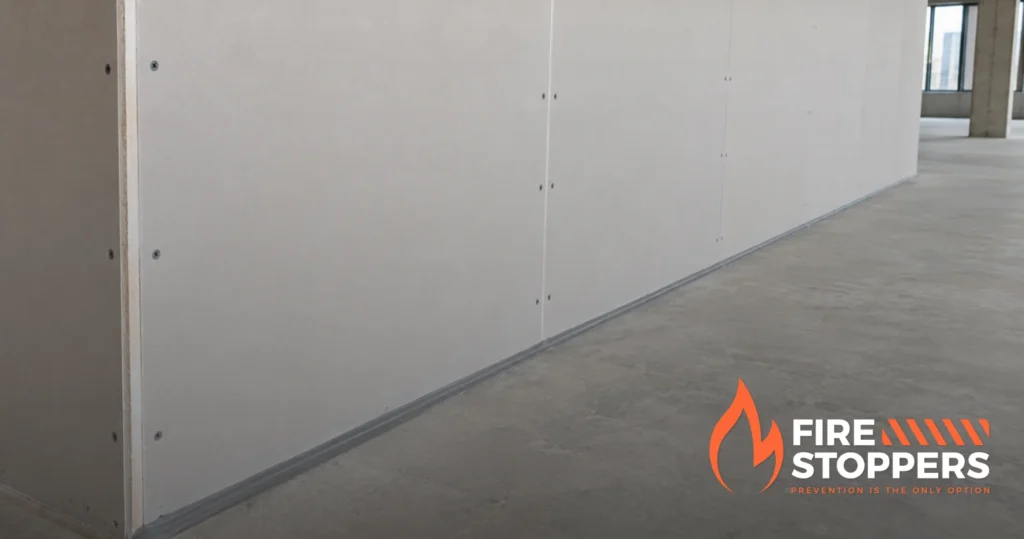
Fire-rated sealants, mastics and foams are products that plug the gaps around doors, services (pipes, cables and ducts) and joints, which is the job of fire stopping. Sealants and mastics are gun-applied pastes, and foams expand out of a can. They are three of the tools alongside putty pads, collars, batts and compounds. You may also see “fire caulking”, which is the American name for a sealant.
They work in one of two ways. Intumescent products sit quietly until heat reaches them, then swell to shut the gap. Non-intumescent products resist the heat and stay put, which only works when the gap is small enough for the cured material to fill it completely.
The words on the tube don’t help. “Fire retardant” usually describes how a material reacts to flame. “Fire resistant” and “fire rated”, as in a fire-resistant sealant, describe how many minutes a tested joint or penetration holds. For a gap in a fire-rated wall, the minutes are the number you need.
Is Intumescent Mastic a Fire Stopping Material?
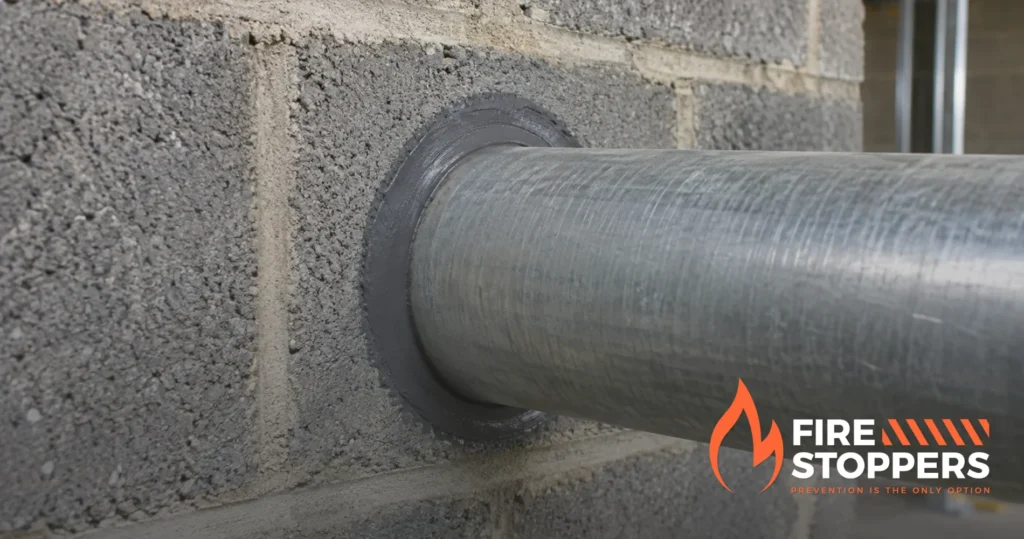
Yes. Intumescent mastic is one of the main fire stopping materials, provided it goes into the joint or penetration it was tested for. Heat triggers a reaction inside the mastic that makes it swell into an insulating char, and that char holds back fire and smoke. Intumescent mastics are made for linear joints, such as where a wall meets a floor, and for gaps around services, and many also keep the acoustic performance of the wall intact.
The 4 hours quoted on many tubs is a ceiling. The fire resistance you get depends on the joint design, the depth of sealant and the surfaces it bonds to. And mastic can’t hold a melting plastic pipe on its own, so plastic pipes need an intumescent collar or wrap, with mastic sealing the edges.
So mastic does the work. The harder question is how it differs from the other products on the shelf.
What Is the Difference Between Fire-Rated Mastic, Sealant and Silicone?
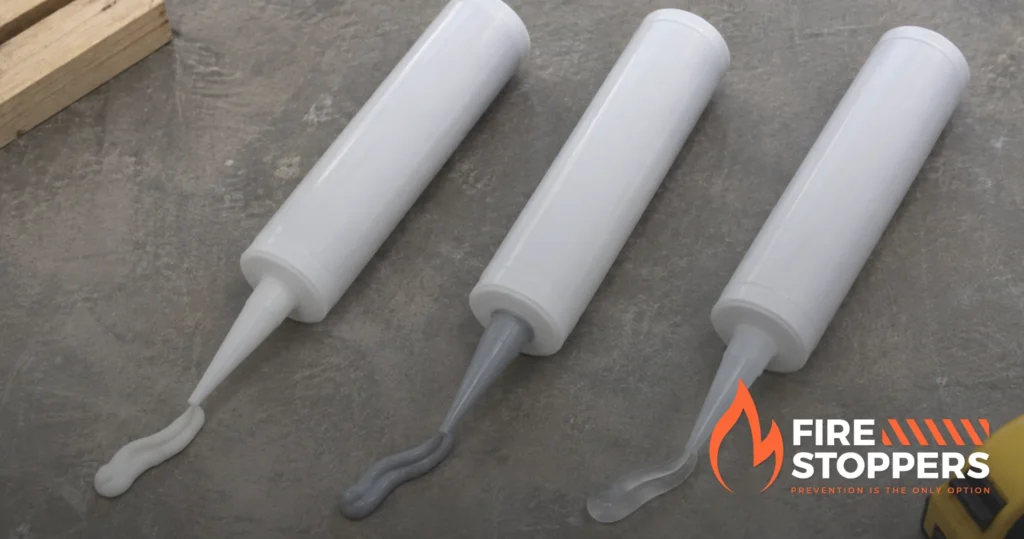
In fire stopping, mastic and sealant are mostly the same thing. “Mastic” is the trade word for a thick, gun-applied, paste-like sealant, and “intumescent mastic” and “intumescent acrylic sealant” usually describe the same product. Sealant is the wider category. It also takes in hybrid and silicone products.
Silicone is the real difference. Silicone sealants are generally non-intumescent, highly heat resistant and flexible, and some are tested for fire-rated joints. Ordinary silicone, the kind you would run round a bath, typically carries no fire rating.
So is mastic better than silicone? Neither wins by default. Acrylic mastic suits dry interior joints and can usually be painted, though test the paint on a scrap first. Fire-rated silicone copes better with weather but won’t take paint.
Fire cement and high-temperature sealants are a third category. They are mostly made for stoves, flues and boilers. A rating of 1,250°C tells you what the material survives. It doesn’t tell you that anyone has tested it to hold a gap in a fire-rated wall.
What Types of Fire-Rated Sealant, Mastic and Foam Are There?
There are five types: intumescent acrylic mastic, hybrid and elastic sealants, high-expansion intumescent sealant, fire-rated silicone and fire-rated polyurethane foam. Each should have a datasheet, the manufacturer’s technical sheet that sets out how the product is meant to be used. It is usually available to download from the maker’s website.
Intumescent Acrylic Mastic
Intumescent acrylic mastic is the most common type. It is water-based and bonds to masonry, plasterboard and timber. Colours run from white and grey to black or brown.
Fire-Rated Hybrid and Elastic Sealants
These are for joints that move. Many are tested for linear joints and carry a stated movement allowance, so match it to how much the joint will flex. Some also suit exterior use.
High-Expansion Intumescent Sealant
It contains graphite that expands hard under heat. It is used on service penetrations and complex openings where a standard mastic isn’t enough.
Fire-Rated Silicone
Fire-rated silicone is only as good as the list of joint types on its datasheet. Check that list against your joint before you buy it.
Fire-Rated Polyurethane Foam
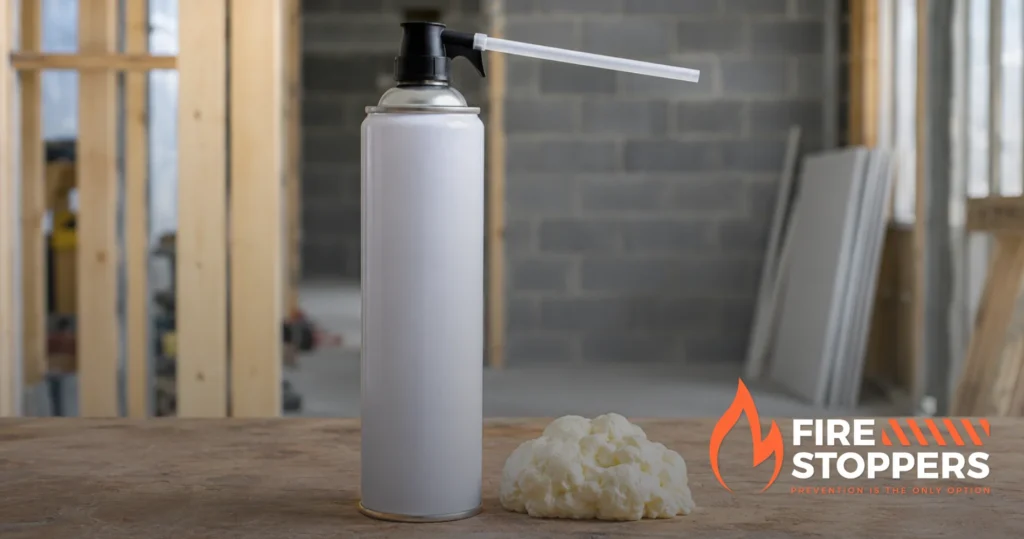
Fire-rated polyurethane (PU) foam, also sold as fire stopping foam, comes in 750ml cans, hand-held or gun grade, and is usually for interior use only. Foam sets hard and never swells again in a fire, so it belongs in small linear gaps and around door frames. Around plastic pipes and cables the services burn away and leave a void, so use an intumescent product there. Foam datasheets state a maximum gap width.

Which Fire Stopping Product Suits Which Gap?
The gap decides the product. The table shows the usual match, and the datasheet for your product has the last word.
| The gap | What usually suits it | What to watch |
| Between a fire door frame and the wall | Fire-rated foam, or intumescent or hybrid sealant | Standard expanding foam has no fire rating. A gap wider than the datasheet maximum needs a different fix |
| Linear joint, such as wall to floor slab or wall head | Intumescent acrylic or hybrid sealant, packed to the tested depth | Joint movement. Choose an elastic sealant if the joint will flex |
| Metal pipe or cable through a wall or floor | Intumescent or high-expansion sealant inside a tested system | Dense cable trays need products made for them, not a bead of sealant |
| Plastic pipe through a wall or floor | Intumescent collar or wrap, sealed at the edge with mastic | Sealant alone leaves a hole when the pipe melts |
| Large opening with several services | Mineral wool batts with coating, with edges sealed in mastic | Foam is the wrong tool for large voids |
| Electrical sockets and back boxes | Putty pads | See fire stopping around electrical sockets for the detail |
Not sure which row your gap falls under? Get my building surveyed
Can Rockwool Be Used as a Firestop?
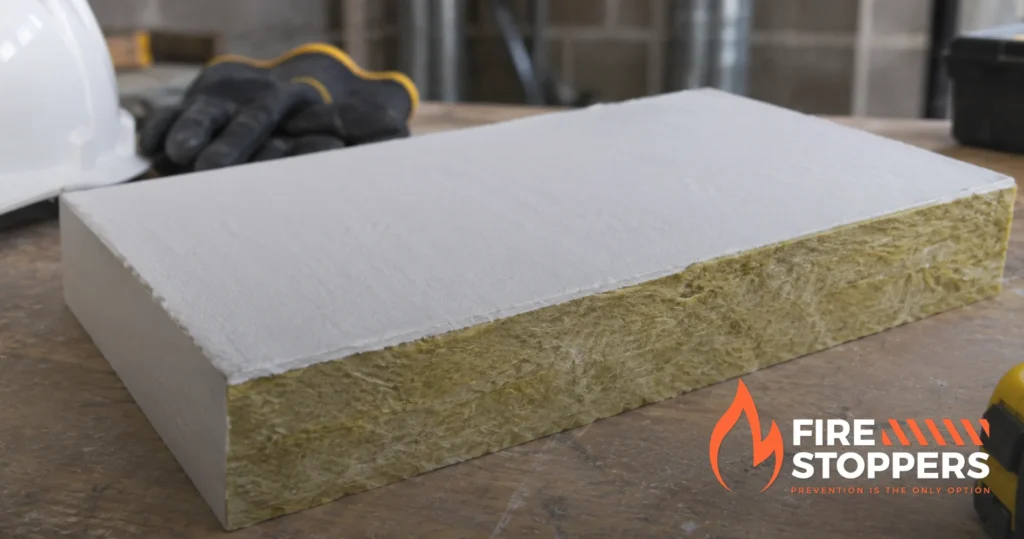
Yes, as part of a tested system. On its own, no. Rockwool is a brand of mineral wool, which is non-combustible and so appears in fire stopping. A loose bundle pushed into an opening is still not a tested seal.
Fire batts are the tested version. They are mineral wool boards, usually with an ablative coating, cut to fit large or irregular openings. Mastic goes on every contact edge between batt and opening, and the coating repairs damaged faces and covers cut edges. Ablative coating forms a char without swelling, which slows the passage of heat and smoke.
Fire compound is another option for sealing gaps and openings in walls and floors.
How Do You Apply Fire-Rated Mastic?
Follow the datasheet, because it holds the tested gap width, depth and surface.
- Clean the joint. Remove dust, loose plaster and oil. Some products want a primer on porous surfaces and some foams want the surface dampened first.
- Pack deep joints with backing to the depth the test specifies. Some datasheets set a minimum depth around services, so a bead that looks full can still be too shallow.
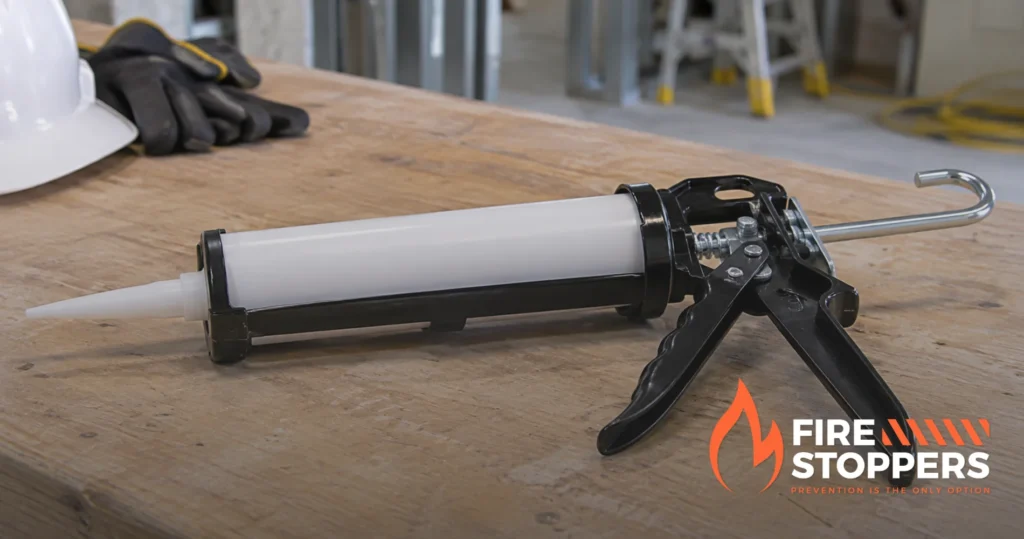
- Gun the mastic in one continuous pass. Push it into the joint so it bonds to both sides with no voids.
- Tool it smooth, then leave it to cure before you paint or close up.
- Keep the components of a system from the same manufacturer unless its test evidence covers the mix. Anything else steps outside what was tested.
Those steps are only the outline.
Once it is in, how long does it keep doing its job?
How Long Does Fire Mastic Last?
An unopened cartridge commonly lasts 12 to 18 months from production if stored as the pack directs, so check the date on the pack.
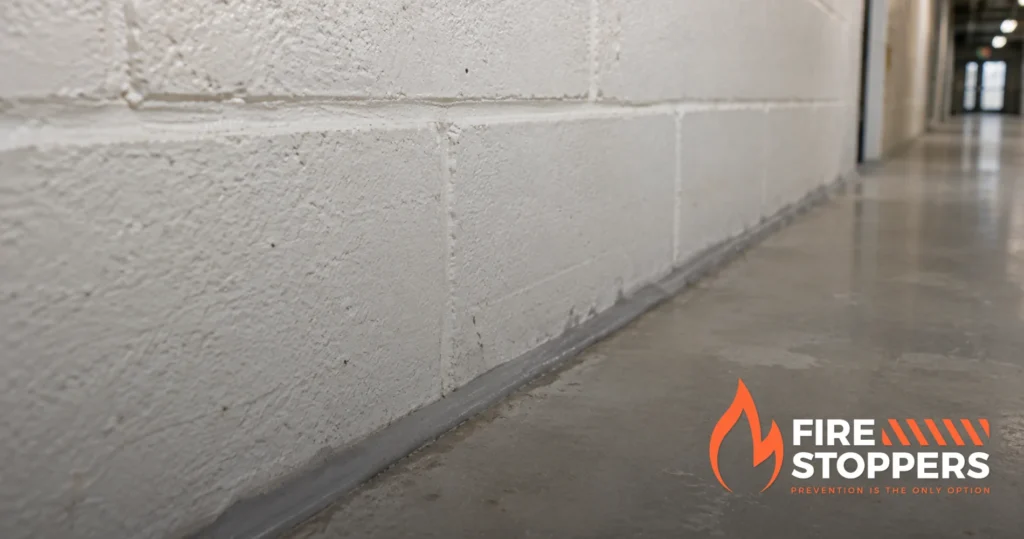
Once cured, the joint has no expiry date. Published product assessments typically assume a working life of around 10 years, and they describe that as guidance only.
What shortens a joint’s life is disturbance. Cables pulled through it, a floor replaced beside it, a new service added later. Look at it whenever someone has worked nearby.
Fire mastic is generally not waterproof, so where the joint sits matters. A joint in a damp or exposed spot will age faster than one in a dry interior. Check the datasheet for the exposure the product was tested for.
When Should You Call a Fire Stopping Specialist in Ireland?
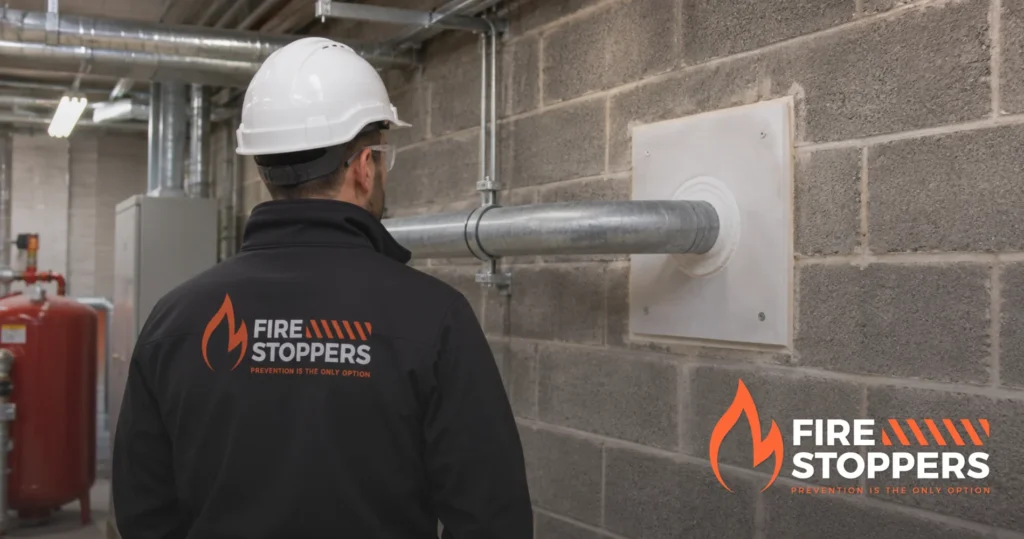
Call someone in when gaps around services run through several places, or when plastic pipes and cable trays are involved.
The same goes for a building where nobody can say who sealed what, and for work that has to happen while people are using the space. In November 2026, Irish retailers listed fire-rated sealant cartridges at roughly €3 to €13 and foam cans at roughly €13 to €24, before delivery.
Choosing the right product, matching it to the gap and proving afterwards that it went in correctly is the expensive part.
Firestoppers is a passive fire protection specialist serving all 32 counties. It surveys the building, specifies the right product for each gap, installs it and hands over installation records and maintenance recommendations. Most sealing is targeted, section-by-section work, so an occupied building can usually stay in use.
If you only need the material, intumescent mastic seals are on the products page, and the wider service sits under passive fire protection.
If you cannot say what went into a gap, treat that gap as unchecked.
Need a survey or an installation quote? Get my building surveyed or call 01 816 5587. Every enquiry gets a reply within 24 hours.